What if Malaysia counted votes differently? Re-run any general election under proportional representation — D'Hondt, Sainte-Laguë or largest-remainder — and watch the seats move, in a parliament arc.
🔗 Live: https://zachtheyek.github.io/undi-lain/
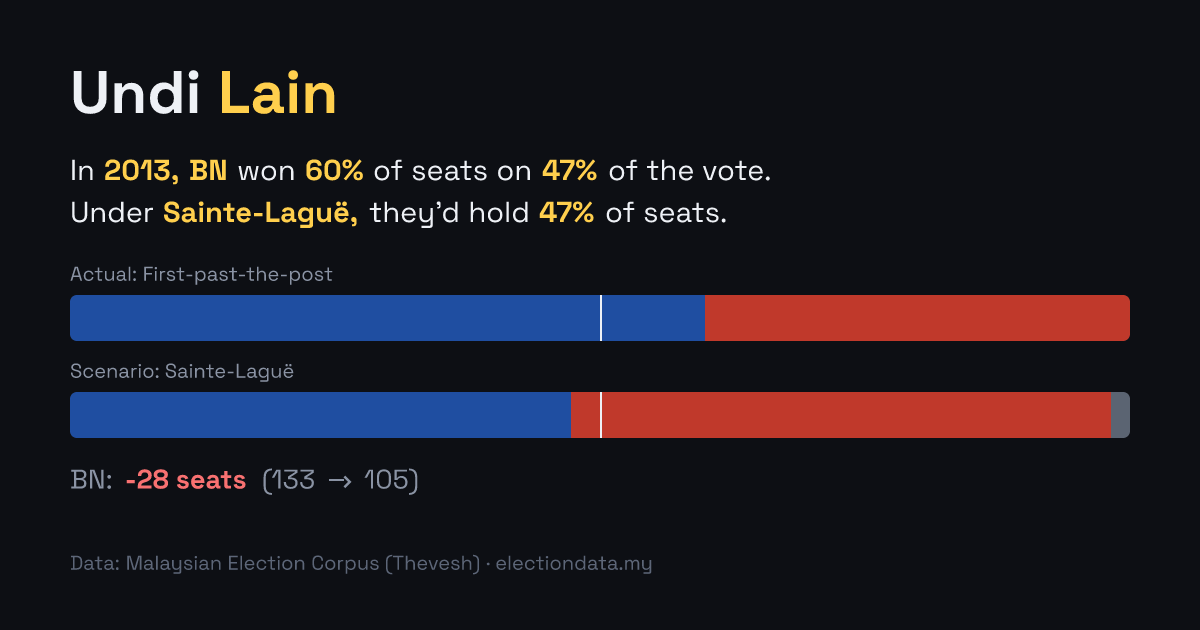
First-past-the-post doesn't just pick winners — it distorts. In 2022, BN won 22% of the national vote but only 30 of 222 seats; under Sainte-Laguë it would have won 49. GPS, with 4% of the vote concentrated in Sarawak, took 23 seats — under PR, just 9. Disproportionality (Gallagher) falls from 8.0 to 0.3.
Pick any of 16 general elections (1955–2022), any of three PR methods, and an optional electoral threshold, and see exactly how the chamber changes.
- A Results card with two parliament chambers side by side — the actual
first-past-the-post result and the chosen PR scenario — plus the headline, the
"N seats change hands" count, and a bloc table where the change is the centrepiece
(logo, vote share, and the seat swing as a coloured delta beside
(30 → 49)). - A Fairness readout — the Gallagher index for FPTP and the chosen system on one scale, so you watch the gap close (lower = fairer).
- Animated explainers for every system. The biggest barrier here is jargon: most readers don't already know what D'Hondt or the Gallagher index are. So each system plays a short, hover-to-replay animation of how it shares out the same eight seats among the same four blocs — bars growing, seats handed out one by one, winners penalized per seat (Sainte-Laguë penalizes harder than D'Hondt), ending on who forms the government — with a one-line gist (e.g. "rewards big players") and an ⓘ card for the detail. The selected system keeps playing, and clicking it again de-selects it (leaving just the actual chamber). First-past-the-post is the fixed baseline.
- A coalition builder. When a chamber is hung, tap blocs to assemble a government; the selected seats stay lit, the rest mute, and the line flips to "… have a majority" once you cross it.
- Shareable scenarios. Every election×system has a clean URL
(
/s/<election>/<system>/) prerendered with its own before/after seat-map OG card, so a shared link shows the distortion, not a generic image.
Seats are re-allocated nationally in proportion to each bloc's share of the national vote. This is a deliberate simplification of real-world PR (which uses multi-member districts), chosen so the headline distortion is exact and explainable. The unit is each bloc = its coalition, or its party if unaligned.
The allocation methods live in src/allocate.ts and are
unit-tested (src/allocate.test.ts) against the
canonical textbook worked examples — npm test. The animated per-system explainers
in src/anim.ts play out the real algorithm on one shared four-bloc
example (A 80 · B 120 · C 30 · D 20 over 8 seats), with every division shown exactly
(votes ÷ divisor), so what they show is how the method actually distributes seats.
All underlying data is the Malaysian Election Corpus (MECo) by Thevesh Thevananthan (electiondata.my, CC0). Not affiliated with the author.
The site self-updates. public/data/ is not committed — it's generated
from the shared meco-data foundation
during the GitHub Actions build. The deploy workflow runs weekly; on each scheduled
run it first diffs the live data stamp against meco-data's current commit and only
rebuilds if the upstream data actually moved (pushes and manual runs always build).
No manual step is needed in steady state. Party/coalition logos in
public/logos/ are committed assets (mirrored from undi-wrapped).
npm install
npm run data    # build_data.py: ../meco-data/out → public/data/elections.json
npm test        # vitest — allocation methods
npm run dev
npm run build # tests + vite + OG cards + prerendered scenario pagesPart of a family of civic data-viz tools built on the Malaysian Election Corpus:
- Undi Wrapped — your constituency's election story, Spotify-Wrapped style
- Lompat — every party-hop since 1955, and the "frog" leaderboards
- Salasilah — the family tree of Malaysia's parties & coalitions
- Nadi Demokrasi — the health of the democracy in fourteen indicators
- Undi Generasi — how Malaysia votes across generations
Code: MIT. Data: CC0 (MECo / Thevesh Thevananthan).