



AI agents drift. Logs don't stop them.
sovereign-seal is a deterministic governance layer that halts an agent unless it can prove:
- its history is intact,
- its witnesses agree, and
- its output passes your rules.
Most agent frameworks focus on coordination: prompting, retrying, and hoping the LLM behaves. sovereign-seal shifts the paradigm to specification. It moves the invariant from a prompt to a cryptographic invariant.
from sovereign_seal import SovereignSeal

seal = SovereignSeal("./ledger")
seal.append(action="deployed model v2", metadata={"model": "gpt-4o"})
seal.verify()  # replays full chain — passes or raises
seal.halt_or_proceed(witnesses=["./replica1", "./replica2"])
Zero dependencies. Standard library only. Python 3.8+.
Note: Ledgers are single-writer. If multiple agents run concurrently, give each agent its own ledger directory.
pip install sovereign-sealOr from source:
git clone https://github.com/prohormonePro/sovereign-seal.git
cd sovereign-seal
pip install -e .python examples/live_halt_demo.py--- Scenario 1: Clean output ---
[PASS] Agent may proceed. Output sealed.
--- Scenario 2: Hype with no evidence ---
[HALT] Voice drift: no_unverified_claims
The agent was stopped. The output was not sent.
--- Scenario 3: PII exposure attempt ---
[HALT] Voice drift: no_pii_exposure
The agent was stopped. PII was not exposed.
--- Scenario 4: Witness drift ---
[HALT] Witness drift detected: replica
Even with clean output, stale witnesses = halt.
The system chose silence over proceeding unverified.
3 halts, 1 pass. The system refused 3 times. That's the feature.
-
Chain integrity — Every action is SHA-256 hashed into an append-only ledger. Each entry chains to the previous. Tamper with one line and every line after it breaks. Detected. Halted.
-
Witness consensus — Before acting, the system checks that all replica nodes agree on the current tip. Stale pointers, network partitions, silent corruption — all caught before damage. Halted.
-
Voice governance — Output passes through your rules before release. PII exposure, banned phrases, missing evidence — define checks as simple Python functions. Any failure = halted.
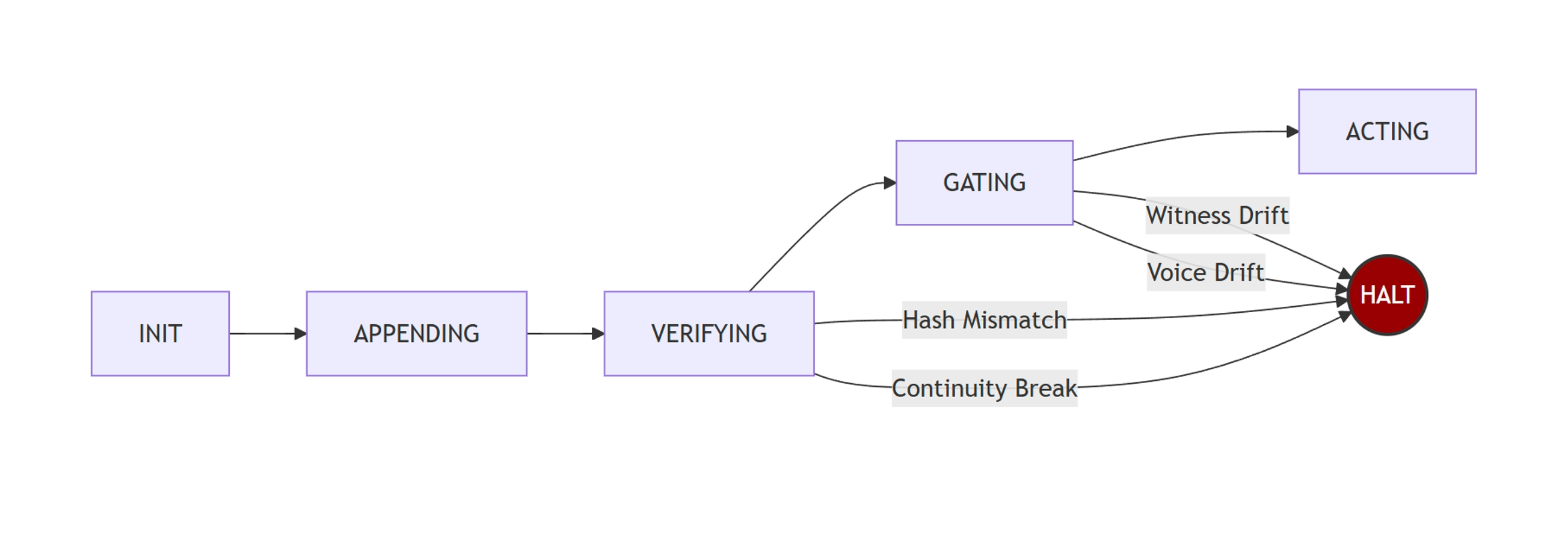
Mermaid source (renders on GitHub)
graph LR
    A[INIT] --> B[APPENDING]
    B --> C[VERIFYING]
    C --> D[GATING]
    D --> E[ACTING]

    C -- "Hash Mismatch" --> F((HALT))
    C -- "Continuity Break" --> F
    D -- "Witness Drift" --> F
    D -- "Voice Drift" --> F

    style F fill:#900,stroke:#333,stroke-width:2px,color:#fff
The fastest way to governance-wrap any agent:
from sovereign_seal import SovereignSeal, SealError

seal = SovereignSeal("./ledger")
replica = "./replica"

def no_pii(text):
    return "ssn:" not in text.lower()

def must_cite(text):
    return any(w in text.lower() for w in ["study", "data", "tested", "verified"])

def governed_respond(agent_output: str) -> str:
    """Returns the output only if governance passes. Otherwise raises."""
    seal.halt_or_proceed(
        witnesses=[replica],
        voice_checks=[no_pii, must_cite],
        voice_input=agent_output,
    )
    seal.append(action="response emitted", metadata={"len": len(agent_output)})
    seal.export_tip(replica)
    return agent_output

# Usage:
try:
    safe = governed_respond(my_agent.run(query))
    send_to_user(safe)
except SealError as e:
    log_halt(e)  # agent was stopped
Copy, paste, run.
from sovereign_seal import SovereignSeal

seal = SovereignSeal("./agent_ledger")

# Before any chain.invoke():
seal.halt_or_proceed(witnesses=["./replica"])

# After execution:
seal.append(action="chain.invoke completed", metadata={"input": query})
seal.export_tip("./replica")seal = SovereignSeal("./assistant_ledger")
# Before sending response to user:
seal.halt_or_proceed(
voice_checks=[no_pii, no_hallucinations, must_cite_sources],
voice_input=assistant_response,
)
seal.append(action="response sent", metadata={"thread": thread_id})seal = SovereignSeal("./multi_agent_ledger")
def governed_step(agent, task):
seal.halt_or_proceed(witnesses=["./witness1", "./witness2"])
result = agent.execute(task)
seal.append(action=f"{agent.name}: {task}", metadata={"result": result})
seal.export_tip("./witness1")
seal.export_tip("./witness2")
return result| Approach | What it does | What it doesn't do |
|---|---|---|
| Prompt-based safety | Asks the model to behave | Doesn't enforce. Model can ignore. |
| Logging | Records what happened | Doesn't prevent what happens next. |
| Guardrails / NeMo | Pattern-matches output | No chain integrity. No witness consensus. No cryptographic proof. |
| sovereign-seal | Halts unless proven safe | That's the difference. |
Logging tells you what went wrong after. sovereign-seal prevents it before.
| Attack | Detection | Response |
|---|---|---|
| Corrupt a ledger entry | HashMismatch at the exact line |
Halt |
| Break prev_hash chain | ContinuityBreak at the break point |
Halt |
| Stale witness pointer | WitnessDrift listing disagreeing witnesses |
Halt |
| Missing witness | WitnessDrift with tip=MISSING |
Halt |
| Banned output content | VoiceDrift naming the failed check |
Halt |
| Missing evidence markers | VoiceDrift naming the failed check |
Halt |
Every failure mode is the same: halt. The system does not degrade gracefully. It stops and tells you why.
Initialize a governance layer. Creates an append-only NDJSON ledger.
Append an entry to the chain. Returns a SealEntry with the computed hash.
Re-verify the entire chain from genesis. Rebuilds every preimage, recomputes every hash.
Raises: ContinuityBreak, HashMismatch
The governance gate. Three checks. Any failure = halt.
Raises: ContinuityBreak, HashMismatch, WitnessDrift, VoiceDrift
Replicate the current tip hash to a witness node directory.
python -m unittest tests.test_adversarial -v15 tests. 5 attack categories. All deterministic. No flaky tests.
- Corrupt entry →
HashMismatchat exact line - Break chain →
ContinuityBreakat exact line - Witness drift →
WitnessDriftnaming drifted witnesses - Voice drift →
VoiceDriftnaming failed check - Full replay (100 entries) → Tamper at line 50, caught at line 50
- Hash continuity:
E[i].prev_hash == E[i-1].entry_hashfor alli > 0 - Preimage binding:
E[i].entry_hash == SHA256(preimage(E[i]))where preimage is canonical JSON excludingentry_hash - Witness agreement:
W[j].tip == local.tipfor all witnesses at gate time - Voice compliance:
C[k](output) == Truefor all registered checks
The system raises (does not proceed) when any invariant is violated. There is no "warn and continue" mode.
| Mode | Cause | Recovery |
|---|---|---|
| Corrupted entry | Bit flip, disk error, malicious edit | Restore from witness replica |
| Chain break | Reordered/deleted entry | Restore from witness replica |
| Witness drift | Network partition, stale pointer | Re-publish tip, re-verify |
| Voice drift | Agent hallucination, policy violation | Regenerate output, re-gate |
Extracted from a production governance pipeline running 225+ sealed stages across three AI providers (Anthropic, Google, OpenAI) with cryptographic verification on every output.
Built by Travis Dillard at ProHP LLC.
The core insight: alignment isn't about making models smarter. It's about making systems willing to stop.
MIT. Use it. Fork it. Ship it.