

Highlights · Fastest start · For parents · For makers · Documentation · Support the project · Contributing · Version history
A family of virtual pets on M5Stack hardware. Three pet variants — Muffin (CoreS3 + LLM), Visu (CoreS3 alone), Goo-Goo (Core2) — plus one optional accessory, Pip (M5StickC PLUS2), which acts as a pocket-sized companion device for any of the bigger pets. One source tree, five build envs (cores3 / visu / core2 / pip / pip-s3). Pet logic, animations, mini-games, ESP-NOW friends and weather/location are target-agnostic; voice and the front camera are CoreS3-only.
Version 1.0.3 — small follow-up to 1.0.2 fixing a Pip-S3 deep-sleep wake bug + correcting the S3 download-mode docs for the K150 hardware. See Version history at the bottom for the per-version scope.
👨👦 A note from the makers
Pixel Pets started as a Sunday afternoon between a dad and his 10-year-old son, Justus, sitting on the sofa together. Every line of firmware was co-authored with Claude (Anthropic) under our direction.
Justus checks the GitHub star count on Sundays. If you think a 10-year-old shipping a kid-safe AI pet on real M5Stack hardware is cool, drop a ⭐ and make his weekend. The full story is in
CREDITS.md.

The whole family on the desk: Muffin showing the dog pet, two Goo-Goos showing the bear and cat, with a Pip on the Tricks page in front.

10 seconds with a Goo-Goo on the desk — click the cover to watch (1.5 MB MP4). German-captioned variant at demo-de.mp4.
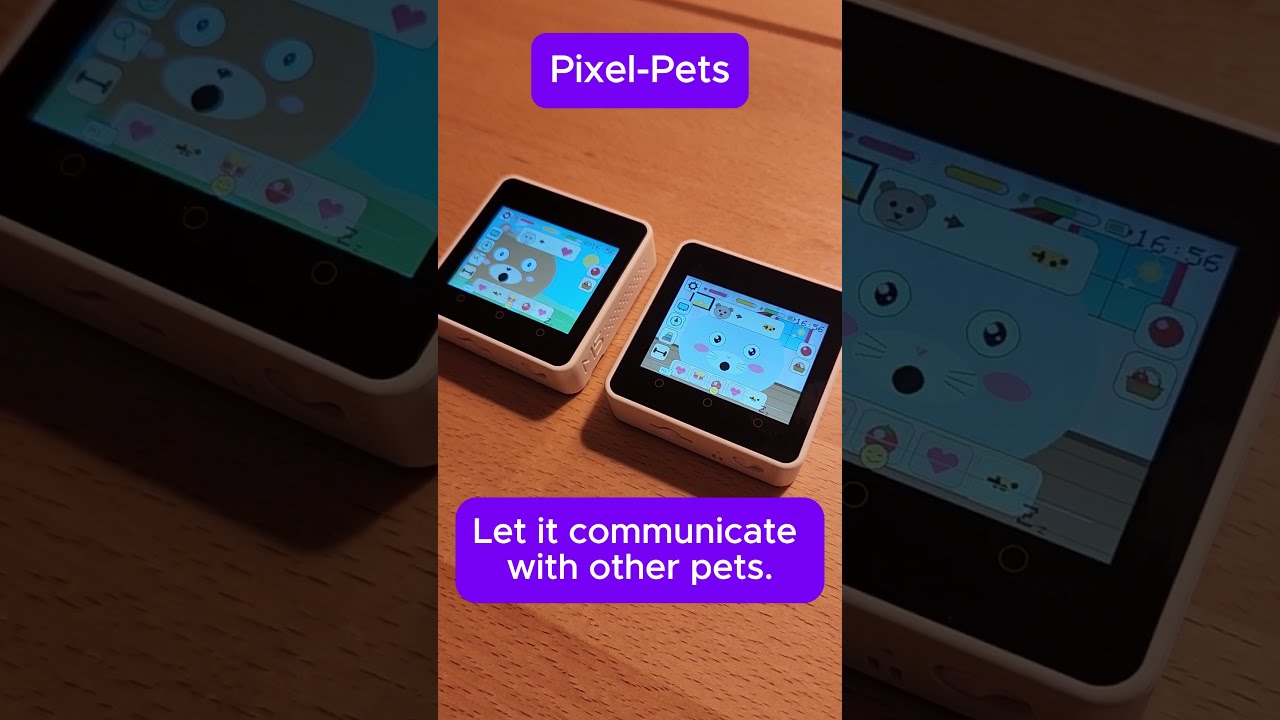
2 minutes in action — voice control on Muffin, gift exchange between two pets via ESP-NOW Friends mode, and a Pip wrist-flick treat throw. Click to watch on YouTube.
A 7-minute deep dive into the project, safe hardware for kids, and how 10-year-old Justus built this with Claude AI. Also available in German.
Each device renders the same set of animals — Bear, Cat, Dog — chosen on first boot (and changeable later in Settings). Real screenshots from a Goo-Goo (Core2):
| Bear | Cat | Dog |
|---|---|---|
 |
 |
 |

Goo-Goo on a meadow scene — what the bear looks like through a phone camera.
Where to find Pixel Pets:
- 🐻 Live landing page — short intro, real-hardware video and an overview of all variants. Source under
site/, deployed via GitHub Actions on every push. - 🛠️ Build write-up on Hackster.io — the assembly story, build photos and Q&A in the maker-community format.
- 💻 Source on GitHub — you're already here.
- Three animals × three pet variants — pick Bear / Cat / Dog on first boot (changeable later in Settings), running on Muffin (CoreS3 + LLM), Visu (CoreS3 alone) or Goo-Goo (Core2). Same source tree.
- World-aware pet — at boot the device looks up your location (IP geolocation via ip-api), pulls real weather, sunrise / sunset times and the moon phase from open-meteo, and adapts the scene to the actual time of day at your location: pale-blue Morning sky → clear Day sky → muted Evening dusk → dark Night with a crescent moon. The sun and clouds tint with the same phase. All cached in NVS so it survives reboots offline.
- Battery-backed clock + NTP sync — wall-clock time is synced once a day over Wi-Fi and persisted by the RTC in between, so the time-of-day rendering and the parental session limit work even with no network on a given day.
- Voice control (Muffin only) — wake word "Muffin", offline Whisper speech-to-text + Qwen3-0.6B intent classifier running on the Module-LLM expansion. Plain sentences ("eat something", "let's dance", "turn on the radio") trigger matching actions. No cloud, no audio leaves the device.
- Front camera + selfies (Muffin / Visu) — proximity-wake when you walk past, photo button overlays the pet on a selfie, 5-slot LittleFS gallery with delete.
- ESP-NOW Friends + Pip accessory — two pets in range pair with a synchronised tap and exchange gifts / hearts / food / toys over ESP-NOW (no router needed). The optional Pip (M5StickC PLUS2) acts as a pocket-sized treat thrower: pick Apple / Carrot / Bone with BtnA, wrist-flick to throw, home pet eats it within ~200 ms.
- Web radio — WDR Die Maus (DE) / Fun Kids UK (EN) in the media menu, pet sways to the music; voice-triggerable on Muffin.
- Mini-games + scenes — squat / jump / yoga workouts, butterflies / mushrooms / surf / scorpion / asteroids / cross-the-street per scene, foraging for apple / berry / fish, five toys with boredom mechanics, scene travel between Bedroom / Meadow / Forest / Beach / City / Desert / Space.
- Parent dashboard — captive-portal Wi-Fi setup, optional
<pet>-setup.localweb server for live stats and remote-edit of the daily play-session limit (5–120 min). Session expiry triggers a 30-minute lockout that survives reboots. - Eleven moods + gestures — Idle / Happy / Excited / Love / Sleepy / Sleeping / Sad / Startled / Laughing / Eating / Speaking, driven by happiness / energy / fullness needs. Touch zones (forehead / cheeks / mouth / ears), IMU-based petting / shake / stand reactions, somersault on circle drag, sing-and-applause when tilted upright.
See the Version history for the full per-target breakdown.
The three pets:
| Target | Board | Branding | Voice | Camera | Hard buttons | Display | Audio | Web radio |
|---|---|---|---|---|---|---|---|---|
cores3 |
M5Stack CoreS3 + Module-LLM | "Muffin" | ✅ Wake word + Whisper + Qwen3 | ✅ | ❌ Touch strip | 320×240 | WAV | ✅ |
visu |
M5Stack CoreS3 without module | "Visu" | ❌ | ✅ | ❌ Touch strip | 320×240 | WAV | ✅ |
core2 |
M5Stack Core2 | "Goo-Goo" | ❌ | ❌ | ✅ BtnA/B/C | 320×240 | WAV | ✅ |
The accessory:
| Target | Board | Role | Display | Audio |
|---|---|---|---|---|
pip |
M5StickC PLUS2 (ESP32 PICO) | Pocket-sized companion to a bigger pet — sends treats and gestures over ESP-NOW. Doubles as a tiny pet face when out of range. | 135×240 | Buzzer |
pip-s3 |
M5StickC PLUS2 (S3 revision) | Same role, ESP32-S3 board variant. | 135×240 | Buzzer |
Pick one pet plus optionally a Pip as a pocket-sized accessory. Direct links to the M5Stack official store; all USB-C, no soldering, no breadboard.
| Pet | Required parts | M5Stack store links |
|---|---|---|
| Muffin | M5Stack CoreS3 + M5Stack Module LLM (AX630C) + Battery Module 13.2 (1500 mAh — separate purchase, not bundled with the LLM module). | CoreS3 · Module LLM (AX630C) · Battery Module 13.2 |
| Visu | M5Stack CoreS3 + M5GO Battery Bottom3 (500 mAh, official CoreS3 accessory). | CoreS3 · Battery Bottom3 |
| Goo-Goo | M5Stack Core2 (built-in 500 mAh battery, no extra parts). | Core2 |
| Pip | M5StickC PLUS2 (built-in 200 mAh battery, no extra parts). StickC PLUS2 |
Pip is not a fourth pet. It's a tiny ESP-NOW remote that pairs with any of the three home pets above. Display shows the next treat the kid will throw (Apple / Carrot / Bone, BtnA cycles); a quick wrist-flick fires an ESP-NOW broadcast and within ~200 ms the home pet eats the treat (Face::Eating + Eat sound + Apple/Heart floats + happiness/fullness boost).
Pet-mode owners enable reception via Settings → Pip mode (page 4). The toggle is off by default — the always-on listener costs ~20 % battery runtime on the bigger pet, so opt-in is honest. Pip itself stays radio-off until each shake (sender powers up the radio for ~150 ms per throw), so its 200 mAh battery is essentially unaffected.
The treat-thrower flow is shipped end-to-end and verified on hardware. See src/pip_link.h (listener API), src/pip/pip_link_send.h (Pip-side sender). Other companion ideas (egg/hatchling, pet-mail, remote shutter) are sketched in docs/concept.md but not on the immediate roadmap — Pip is treated as feature-complete for now.
Web radio (in the media menu) plays WDR Die Maus in German and Fun Kids UK in English — no negative side effects, with note-symbol animation and body sway. On cores3 it can also be triggered by voice command ("turn on the radio").
On Muffin and Visu additionally: Photo and Gallery in the media menu. Photo opens the front camera with the pet overlaid in the lower-left corner (pet selfie), tap = capture. Gallery walks through the last five photos with left/right-tap navigation. Both reward happiness without negative effects.
Pixel Pets is a DIY maker project, but it is designed with families in mind.
- No cloud account is required for the core pet experience.
- No tracking or subscription model is built into the firmware.
- The code is open source and can be inspected, changed and flashed yourself.
- A configurable parental session limit is included.
- The project works best as a shared maker activity: assemble, flash, test, name the pet and invent new interactions together.
Pixel Pets is not a certified commercial toy. Adult setup and supervision are recommended.
Pixel Pets is also a compact playground for embedded interaction design:
- ESP32 / M5Stack firmware with PlatformIO
- one source tree with multiple hardware targets
- shared pet state and rendering logic
- touch, buttons, IMU, camera and audio integration
- ESP-NOW communication between devices
- optional offline voice pipeline on CoreS3 + Module-LLM
- world data via WiFi, cached locally
- native unit tests for pure logic modules
Good places to start hacking are new scenes, mini-games, face animations, sounds, Pip interactions or new pet personalities.
Sorted from easiest to hardest setup. Each row links to a self-contained per-pet guide that covers everything (USB driver, env, flashing quirks, gotchas).
💾 Don't want to install PlatformIO? Every GitHub release ships pre-built pixel-pets-vX.Y.Z-<pet>.bin files — single-file flash images at offset 0x0. Use M5Burner ("Custom Firmware" → upload .bin) or esptool.py --chip <esp32|esp32s3> write_flash 0x0 pixel-pets-…bin. Muffin's voice features still need the Module-LLM Linux setup from docs/setup-muffin.md on top of the binary.
| Pet | Hardware | Difficulty | Setup guide |
|---|---|---|---|
| Goo-Goo | M5Stack Core2 | 🟢 Easiest — plug, flash, run | docs/setup-goo-goo.md |
| Visu | M5Stack CoreS3 | 🟢 Easy — same idea on CoreS3 | docs/setup-visu.md |
| Pip | M5StickC PLUS2 (ESP32-PICO or S3 rev.) | 🟡 Medium — the S3 revision needs a manual download-mode procedure | docs/setup-pip.md |
| Muffin | M5Stack CoreS3 + Module-LLM | 🔴 Advanced — extra hardware + ADB / Linux setup on the LLM module (Whisper, Qwen3, gotchas) | docs/setup-muffin.md |
If you're new to the project, start with Goo-Goo (if you have a Core2) or Visu (if you have a CoreS3) — both are roughly an hour from unbox to running pet. Muffin adds another evening for the Module-LLM setup. Pip is optional and only useful once a bigger home pet is running.
pio run -e cores3                              # Muffin (CoreS3 + LLM, default)
pio run -e cores3 -t upload                    # Muffin build + flash
pio run -e visu                                # Visu (CoreS3 alone)
pio run -e core2                               # Goo-Goo (Core2)
pio run -e pip                                 # Pip accessory (StickC PLUS2 PICO)
pio run -e pip-s3                              # Pip accessory (StickC PLUS2 S3)
pio run -e cores3 -e visu -e core2 -e pip-s3   # build all
For per-pet setup details (USB driver, env, flashing quirks, Module-LLM workflow), see the Fastest start table above — every pet has its own dedicated guide under docs/setup-*.md.
src/
  target_caps.h            ← TARGET_HAS_LLM / HAS_CAMERA / HAS_HARD_BUTTONS / ...
  main.cpp                 ← orchestrator (setup + loop) for the big pets
  main_pip.cpp             ← Pip orchestrator (replaces main.cpp on the pip env)
  face.{h,cpp}             ← renderer (PetView-driven)
  pet_state.{h,cpp}        ← pet runtime: RTC, persistence, gaze, touch zones
  needs_logic.{h,cpp}      ← pure happiness/energy/fullness logic (native-testable)
  voice_pipeline.{h,cpp}   ← wake / VAD / Whisper / Qwen3 over UART (HAS_LLM only)
  face_detect.{h,cpp}      ← front-camera face detection + JPEG capture (HAS_CAMERA only)
  photo_store.{h,cpp}      ← LittleFS-backed selfie storage (HAS_CAMERA only)
  webradio.{h,cpp}         ← MP3 stream decoder (HAS_WIFI only)
  pip_link.{h,cpp}         ← ESP-NOW listener for treats/tricks from a paired Pip
  net.{h,cpp}              ← WiFi, captive portal, NTP, ESP-NOW friends, parent server
  world.{h,cpp}            ← IP geolocation + open-meteo + moon phase
  i18n.{h,cpp}             ← string table (DE + EN, switchable at runtime)
  wifi_config.h            ← compile-time WiFi credential defaults
  screenshot.{h,cpp}       ← canvas dumper (SCREENSHOT_MODE only, *-shots envs)
  sounds/                  ← embedded WAV headers (xxd -i)
  pip/                     ← StickC Plus 2-only renderer + tone-based sound engine

docs/
  concept.md               ← gameplay & high-level design
  architecture.md          ← software architecture (modules, build flow, state)
  hardware.md              ← per-pet setup index + capability matrix
  setup-goo-goo.md         ← Core2 (Goo-Goo) setup guide — easiest
  setup-visu.md            ← CoreS3 (Visu) setup guide — easy
  setup-pip.md             ← StickC PLUS2 (Pip) setup guide — medium, S3 download-mode
  setup-muffin.md          ← CoreS3 + Module-LLM (Muffin) setup guide — advanced; Module-LLM ADB workflow + Qwen3 gotchas
  sound_assets.md          ← WAV sample spec and trigger map

site/                      ← GitHub Pages landing page (index.html + scripts + assets)
assets/                    ← master media: logo.jpg, photos/, sounds/, video/
screenshots/               ← real-hardware Bear / Cat / Dog captures used in this README
tools/                     ← Python helpers (uv-managed): shot.py, listen.py, extract_screenshots.py
test/test_needs_logic/     ← Unity tests for the pure-logic needs module (`pio test -e native`)
pkgs/                      ← Module-LLM .deb packages (audio / framework / models / services; .debs gitignored)
.github/workflows/         ← ci.yml (matrix builds + native tests), pages.yml (Pages deploy)

platformio.ini             ← [env:cores3] + [env:core2] + [env:visu] + [env:pip] + [env:pip-s3] + *-shots variants
partitions_cores3_16MB.csv ← partition table for CoreS3 / Visu (incl. LittleFS)
partitions_core2_16MB.csv  ← partition table for Core2
partitions_pip_8MB.csv     ← partition table for StickC Plus 2
CREDITS.md                 ← father-and-son project credits
LICENSE                    ← MIT
docs/concept.md— how the pet ticks: needs, input (touch / IMU / hard buttons / voice / camera), world, mini-games, parental session limit, persistence.docs/architecture.md— software architecture: module overview, build-target system, state model, render pipeline.docs/hardware.md— overview index with the build-target capability matrix; links to the per-pet setup guides:docs/setup-goo-goo.md— Core2 (🟢 easiest)docs/setup-visu.md— CoreS3 (🟢 easy)docs/setup-pip.md— StickC PLUS2 (🟡 medium, S3 download-mode dance)docs/setup-muffin.md— CoreS3 + Module-LLM (🔴 advanced, includes the ADB workflow + Qwen3 gotchas)
docs/sound_assets.md— WAV spec, sample list, trigger map (Pip uses tone sequences instead).
GitHub Actions in .github/workflows/ci.yml:
- Matrix build for all four firmware targets (
cores3/core2/visu/pip). Fails any PR that breaks a build. - Native unit tests (
pio test -e native) for the pure-logic modules insrc/needs_logic.cpp. Tests live undertest/test_needs_logic/and use Unity. Run locally withpio test -e native(Linux/macOS, or Windows with MinGW gcc on PATH).
The firmware has a built-in canvas dumper, gated behind the dedicated *-shots envs in platformio.ini so it never lands in production builds. Flash one of cores3-shots / visu-shots / core2-shots, navigate to the screen you want to capture and hold the PWR button ≥ 2 s — the canvas is dumped over Serial as base64 RGB565. The host-side decoder in tools/extract_screenshots.py turns it into PNGs.
Python tooling is managed with uv — see tools/README.md for the full workflow.
A father-and-son project: Justus Dütscher (10) — ideas, design decisions, tireless field-testing — and Marcel Dütscher (Papa) — translating Justus's ideas for the AI doing the actual coding, plus the bits of technical know-how that don't fit on a kid's whiteboard. The first beta was finished on a Sunday afternoon; the boring polish was Papa's evening work.
Every line of firmware was written by AI assistants — primarily Claude (Anthropic) — under our direction. git log --format="%an %ae" shows which model touched which commit.
See CREDITS.md for the full story, and the in-app credits screen via Settings → Credits.
Pixel Pets is a family project — not a startup, no roadmap, no metrics dashboard. But we'd love for it to find more kids and dads who want to tinker. The cheapest things that genuinely help:
- Drop a ⭐ on the repo. It's the cheapest signal that something resonated, and it really does help the project surface to other curious people scrolling GitHub. Justus checks the count on Sundays.
- Or leave a "respect" on Hackster.io — same idea, different community: project page at hackster.io/marcelduetscher/pixel-pets-….
- Try it with a kid you know. That's actually the most valuable feedback we get — what works, what confuses, what's missing for a 7-year-old vs a 10-year-old.
We'd love your help — code, ideas, bug reports, translations, a new sound, a face animation, an extra language string, a photo of a kid trying it out. All welcome. No CLA, no contributor agreement, no Slack to join. Just GitHub.
- 📘 Contributing guide — setup, conventions, how to get a PR merged. Good first contributions: a new sound, a new scene, a face animation, a mini-game, an extra language string.
docs/architecture.mdexplains where things live. - 💬 Discussions — questions, share what you built, show-and-tell.
- 🐛 Issues — bug reports, feature requests, "Justus has Strong Opinions™ on what feels right; pitch yours".
Small follow-up to 1.0.2. One firmware fix that closes a regression introduced in 1.0.2, and a docs correction so the next person doesn't lose hours to the same wrong setup steps.
Pip-S3 deep sleep now actually wakes back up:
- 1.0.2's "real deep sleep after 3 min idle" plus the USB-PHY detach were both correct, but together they exposed a third bug:
M5Unified::Power_Class::_setupBoard()has no case forboard_M5StickS3in the_wakeupPinswitch, so_wakeupPinstayed at255(GPIO_NUM_MAX).M5.Power.deepSleep(0, true)then skipped itsesp_sleep_enable_ext0/1_wakeup()call, the chip entered deep sleep with no wakeup source at all, and the only way back was a PMIC power-cycle (long-press to force-off → short-press to cold-boot) - 1.0.3 manually configures BtnA (GPIO11, RTC-capable on ESP32-S3) as an
ext1active-low wakeup source before handing off toM5.Power.deepSleep(). Same one-line workaround applied in the brownout-protection boot path so a low-battery sleep doesn't strand the device either. After the fix: a short BtnA press wakes the Stick S3 cleanly from deep sleep, just like the StickC Plus 2 variant has worked all along - The StickC Plus 2 path (
pipenv, ESP32-PICO) is unchanged — its wakeup pin (GPIO35 = power button) was already correctly mapped in M5Unified
Pip setup docs corrected for the M5StickS3 (K150) hardware:
- The old
docs/setup-pip.md"S3 revision" procedure was: "hold BtnA, press the side reset button for ~2 s." That's the original PLUS2 S3 revision procedure, where BtnA happens to be wired in parallel with GPIO0 (the strap pin) and there's a separate hardware reset button on the side. On the newer M5StickS3 (SKU K150) — which is what most people now buy — BtnA is GPIO11 (not GPIO0), and there is no separate reset button (only the PM1 PMIC power button). The published procedure simply could not trigger download mode on K150 hardware - The setup doc now splits the S3 path into two clearly-labelled variants: PLUS2 S3 keeps the BtnA + reset procedure, K150 gets a Hat2-Bus G0 ↔ GND bridge procedure with a PMIC cold-boot trigger. Includes the full 16-pin Hat2-Bus pinout table (G0 on pin 4, GND on pin 1, plus the UART pins for the recovery path below)
- Documented the slow ~1 Hz green LED blink as the visual confirmation that the chip is in ROM bootloader — no need to guess from "display is dark, did it work?"
- Added a UART recovery-flash recipe for the case where the Stick S3's USB-C connector has developed loose D+/D- contacts (power pins still work, hence LED + charging, but USB enumeration is dead even on a fresh OS install). Wire a USB-TTL adapter to Hat2-Bus G43 (TX) / G44 (RX) / GND, enter download mode the usual way, and flash through the adapter with
esptool --before no_reset. Confirmed working as the only path back for one user's stick after the USB-C port wore out across many cold-boot cycles
Small follow-up to 1.0.1. Two real fixes plus a homepage tweak.
Motion-gesture reliability — Spielen / Regen / Singen now clearly distinguishable:
- Lowered the magnitude threshold for both shake gestures (1.0 g → 0.7 g for the play-shake and the rain-shower vertical shake). Reproducibly hard for kid-sized wrist motions to reach 1 g; 0.7 g triggers cleanly without false-firing on accidental jostles
- Vertical-shake dominance ratio relaxed (1.0 → 0.6) so realistic up-down hand motions, which always carry some sideways jitter, qualify for "rain". Required vertical peaks dropped from 2 to 1 — one decisive down-flick is enough; users intuitively flick once for "shower"
- Singing gesture redesigned: was an "upright + tilt-left + tilt-right rising-edge sequence" that broke whenever the pet was already slightly tilted at sequence start (the rising edge never fired). Now it's "heave-up + tilt-left + tilt-right": the user must transition the pet from low (gy<0.4) to upright (gy>0.7) within 800 ms, then complete the L+R tilt within 5 s. The heave guarantees gx ≈ 0 at sequence start so the rising edge fires reliably; a pet just sitting on the desk doesn't trigger because there's no fresh transition
- Help-page 8 updated in DE + EN: "Hochheben, links + rechts kippen" / "Lift it up, tilt left + right"
Pip-S3 robust USB-PHY detach before deep sleep:
- 1.0.1's
Serial.flush()+Serial.end()+ 100 ms grace turned out not to be aggressive enough on every M5-Stick variant — one tested device still disappeared from the host after deep sleep, and only the 60-second-unplug recovery brought it back - 1.0.2 explicitly drives GPIO19 / GPIO20 (the D- / D+ pins on the ESP32-S3) to input + pull-mode floating before
esp_deep_sleep_start(). This collapses the 1.5 kΩ D+ pull-up so the host sees an unambiguous detach instead of a frozen-but-attached device. Grace bumped 100 → 200 ms because Windows sometimes doesn't register the detach in under 200 ms - Plus:
M5.Power.isCharging()is now polled up to 8× with 50 ms gaps at boot. The PMIC's charging-detect isn't stable for the first few ms after power-up — reading it once immediately could falsely returnfalse, sending the brownout-protection branch straight into deep sleep with USB plugged in (and looking like a "won't boot" device to the user)
Site:
- New 2-minute YouTube-Short feature reel section between the hero demo and the deep-dive embed (covers voice control on Muffin, ESP-NOW Friends gift exchange, and a Pip wrist-flick treat throw — all on real hardware). Caption translated DE / EN,
iframeaspect-ratio 9:16 to match the vertical Short format
Reliability release — same features as 1.0.0, but the rough edges that surfaced in the days after launch are fixed. No protocol changes; existing pets keep their NVS state when upgraded.
Friends mode — now actually reliable across all pet pairs:
- Switched the ESP-NOW PHY from LR to standard 802.11 B/G/N. The LR mode had reproducible interop problems between ESP32 (Goo-Goo) and ESP32-S3 (Muffin / Visu) — packets sent in LR didn't decode on the other side
- Pets now run in
WIFI_AP_STAinstead of pureWIFI_STA— the ESP32-S3 stack silently dropped most ESP-NOW broadcast frames in disconnected-STA mode - Once the partner's MAC is known, gift packets switch from broadcast to unicast. 802.11 unicast has ACK + retry at the MAC layer; broadcast was fire-and-forget and the CoreS3 RX path frequently lost it
- Reach-back Ready in the Sending state — the faster tapper used to go silent the moment they matched, leaving the slower partner stuck on "Waiting for friend" until the 60 s timeout
- Smaller initial bursts (1 packet instead of 3-4) and jittered re-broadcast intervals — avoids the "two pets burst into each other" RF collision that froze the rendezvous
Web radio — stutter-free, knacks-free, and tap-resilient:
- Audio decoder now runs on its own FreeRTOS task pinned to core 1, separate from the main loop. Pet animations / touch sampling / friends ticks no longer starve the MP3 decoder mid-frame
WiFi.setSleep(false)while streaming — keeps the radio listening continuously instead of waking only on DTIM beacons- Display sleep no longer kills the audio: the main loop stays at 1 ms cadence as long as media is active
- Pet sound effects (greet / tickle / eat …) are suppressed during radio playback so they don't fight the audio library for the I2S bus — fixes the audible knacks
- Volume slider now actually applies to the stream, live: was hardcoded to ~80 %
- Listen-lock: while the radio plays, the pet ignores every interaction except a tap on the Media button (which still toggles the radio off). Hard buttons A / B / C are gated too. Touching the pet no longer yanks it into a sound-effect animation that stops the music
- "Brauche WLAN" overlay when the radio is tapped without any saved WiFi credentials — bounces back to the chooser instead of silently timing out after 10 s
Pip — no more "bricked-looking" Stick S3:
- The Pip-S3 firmware now explicitly tears down the USB-CDC stack before deep sleep. Without this, the ESP32-S3's D+ pull-up stayed asserted across deep sleep — the host never saw a detach, and on the next reset the device was invisible (no COM port, no
VID 303Aenumeration). Recovery used to require a 60 s unplug or holding the reset pinhole; that's no longer needed - Pip's treat / wand sender is now on B/G/N + AP_STA to match the home-pet receiver after the Friends-mode PHY switch above. Without this fix Pip's announcements wouldn't reach Goo-Goo / Muffin / Visu
Site / CI / docs:
- Site supports
?lang=de/?lang=enURL overrides for shareable language-pinned links - README split into separate Support and Contributing sections, Star-History chart added
- Module-LLM setup script extracted from the README into
scripts/setup-module-llm.shwith a CI lint - Release workflow has a manual dry-run mode for testing before tagging
- Per-env firmware artifacts (
firmware-cores3/firmware-core2/firmware-visu/firmware-pip) uploaded on every CI run, downloadable for 14 days from the Actions page - Dependabot, typos, CodeQL, lychee +
pio checkCI added; CodeQL findings cleared
Smaller bug fixes:
- WiFi-setup screen now shows the correct AP name per target (
muffin-setup/goo-goo-setup/visu-setup) instead of always sayingmuffin-setup - Web radio plays sound on its second start in the same session (was silent because
M5.Speaker.begin()had grabbed the I2S bus back)
First stable release. Three pet variants and one accessory, all verified end-to-end on hardware.
The pets (Muffin / Visu / Goo-Goo):
- 11 moods driven by happiness / energy / fullness needs
- Touch zones (forehead / cheeks / eyes / mouth) + IMU-based petting / shake / stand reactions
- Gestures: somersault on circle drag, wobble on two-finger pull, snuggle on long hold
- Mini-games per scene (squat / jump / yoga / butterflies / mushrooms / surf / scorpion / asteroids / cross-the-street), foraging for apple/berry/fish, toy play with five toys + boredom, scene travel between Bedroom / Meadow / Forest / Beach / City / Desert / Space
- Singing + applause: tilt sequence triggers the pet to sing, mic listens for a loud peak afterwards
- Real weather + sunrise/sunset (open-meteo) and local moon-phase, IP-based location lookup (ip-api), all cached in NVS
- Egg-timer screen with vibration + Goo-Goo cue when it expires
- Parental session limit (5–120 min, configurable via parent web server) with a 30-minute lockout after expiry
- ESP-NOW Friends mode between any two home pets — rendezvous handshake, gift exchange, LR PHY for asymmetric-RF reliability
Muffin only (CoreS3 + Module-LLM):
- Wake word "Muffin" + on-device speech recognition (Whisper) + Qwen3-0.6B intent classifier
- Whisper-first bypass for ~80 % of commands (sub-second latency, no LLM round-trip)
- Voice-triggerable actions (eat, sleep, dance, radio …)
- TTS / wake-WAV side effects neutralised on the LLM module
Muffin / Visu (CoreS3 with front camera):
- Front camera + face / proximity detection — pet greets you when you walk past
- Photo + 5-slot gallery (LittleFS), pet-overlay selfies
Goo-Goo / Visu / Muffin (everything but Pip):
- Web radio (WDR Die Maus / Fun Kids UK), pet sways to the music
- Captive-portal WiFi setup
- Optional parent web server (mDNS
<pet>-setup.local) for stats + session-limit edits
The accessory (Pip — M5StickC PLUS2):
- Pocket companion that pairs with any of the three home pets via ESP-NOW
- Five-page menu (BtnA cycles): "Wähle aus" (safe-carry mode, no shake response) → Apple → Carrot → Bone → Tricks
- Treat thrower: wrist-flick fires a 3-packet broadcast, home pet eats it within ~200 ms
- Tricks: peak-counted gesture → home pet visibly hops N times in a row (giggle sound + heart per landing)
- First-run language picker (DE / EN flags only, no text)
- Long-press BtnA = sleep; auto-sleep after 60 s idle; sleep-click regression on the buzzer fixed
Other lanes that grew along the way:
- GitHub Pages site rebuilt around "three pets + one accessory" framing, click-and-poke browser pet, hardware shopping list
- CI matrix builds all 5 envs on every push; native unit tests for the pure-logic needs module
MIT License — open source, free to use, modify and redistribute.
Note: the web radio feature links against schreibfaul1/ESP32-audioI2S, which is GPL v3.0. Binaries built from the cores3 / core2 / visu envs therefore inherit GPL v3.0 obligations when redistributed. The pip env doesn't link the audio library and stays MIT all the way through. Source code in this repository is MIT regardless of which env you build. See LICENSE for the full third-party-licenses block.