




Universal memory runtime for AI agents. Framework-agnostic, protocol-native, offline-first.
User: "I prefer dark mode and use vim keybindings"
Agent: "Got it!"

[next session]

User: "Update my editor settings"
Agent: "What settings would you like to change?"
User: "I ALREADY TOLD YOU"
# Session 1 — agent stores the preference
p.remember(entity=user, fact="Prefers dark mode and vim keybindings", confidence=0.95)

# Session 2 — agent recalls it automatically
memories = p.recall("editor settings", entity=user)
# → [Memory: "Prefers dark mode and vim keybindings" (score: 0.94)]
Your agent stops being amnesiac. Decisions, patterns, and outcomes persist across sessions — and the right context surfaces when it's needed.
| What you need | How Pensyve solves it |
|---|---|
| Agent forgets everything between sessions | Three memory types — episodic (what happened), semantic (what is known), procedural (what works) |
| Agent can't find the right memory | 8-signal fusion retrieval — vector similarity + BM25 + graph + intent + recency + frequency + confidence + type boost |
| Agent repeats failed approaches | Procedural memory — Bayesian tracking on action→outcome pairs surfaces what actually works |
| Memory store grows unbounded | FSRS forgetting curve — memories you use get stronger, unused ones fade naturally. Consolidation promotes repeated facts. |
| Need cloud signup to get started | Offline-first — SQLite + ONNX embeddings. Works on your laptop right now. No API keys needed. |
| Need to scale to production | Postgres backend — feature-gated pgvector for multi-node deployments. Managed service at pensyve.com. |
| Only works with one framework | Framework-agnostic — Python, TypeScript, Go, MCP, REST, CLI. Drop-in adapters for LangChain, CrewAI, AutoGen. |
pip install pensyve          # Python (PyPI)
npm install pensyve          # TypeScript (npm)
go get github.com/major7apps/pensyve/pensyve-go@latest  # Go
Or use the MCP server directly with Claude Code, Cursor, or any MCP client — see MCP Setup.
pip install pensyveimport pensyve
p = pensyve.Pensyve()
user = p.entity("user", kind="user")
# Record a conversation — Pensyve captures it as episodic memory
with p.episode(user) as ep:
ep.message("user", "I prefer dark mode and use vim keybindings")
ep.message("agent", "Got it — I'll remember your editor preferences")
ep.outcome("success")
# Later (even in a new session), the agent recalls what happened
results = p.recall("editor preferences", entity=user)
for r in results:
print(f"[{r.score:.2f}] {r.content}")p.remember(entity=user, fact="Prefers Python over JavaScript", confidence=0.9)# After a debugging session that succeeded:
ep.outcome("success")
# Pensyve tracks action→outcome reliability with Bayesian updates.
# Next time a similar issue comes up, recall surfaces the approach that worked.p.consolidate()
# Promotes repeated episodic facts to semantic knowledge
# Decays memories you never access via FSRS forgetting curvePrerequisites and build steps
git clone https://github.com/major7apps/pensyve.git && cd pensyve
uv sync --extra dev
uv run maturin develop --release -m pensyve-python/Cargo.toml
uv run python -c "import pensyve; print(pensyve.__version__)"Pensyve exposes its core engine through multiple interfaces — use whichever fits your stack.
Direct in-process access via PyO3. Zero network overhead.
import pensyve

p = pensyve.Pensyve(namespace="my-agent")
entity = p.entity("user", kind="user")

# Remember a fact
p.remember(entity=entity, fact="User prefers Python", confidence=0.95)

# Recall memories
results = p.recall("programming language", entity=entity)

# Record an episode
with p.episode(entity) as ep:
    ep.message("user", "Can you fix the login bug?")
    ep.message("agent", "Fixed — the session token was expiring early")
    ep.outcome("success")

# Consolidate (promote repeated facts, decay unused memories)
p.consolidate()Works with Claude Code, Cursor, and any MCP-compatible client.
cargo build --release --bin pensyve-mcp{
"mcpServers": {
"pensyve": {
"command": "./target/release/pensyve-mcp",
"env": { "PENSYVE_PATH": "~/.pensyve/default" }
}
}
}Tools exposed: recall, remember, episode_start, episode_end, forget, inspect, status, account
Full cognitive memory layer for Claude Code with 6 commands, 4 skills, 2 agents, and 4 lifecycle hooks.
Pensyve Cloud (no build required):
/plugin marketplace add /path/to/pensyve/integrations/claude-code
/plugin install pensyve@pensyve
Then set your API key:
export PENSYVE_API_KEY="psy_your_key_here"The plugin reads PENSYVE_API_KEY from your environment and passes it as a Bearer token in the Authorization header. To override the MCP config explicitly, add to .claude/settings.json:
{
  "mcpServers": {
    "pensyve": {
      "type": "http",
      "url": "https://mcp.pensyve.com/mcp",
      "headers": {
        "Authorization": "Bearer ${PENSYVE_API_KEY}"
      }
    }
  }
}
Note: Use
headerswithAuthorization: Bearerfor remote MCP (HTTP transport). Theenvblock is for local stdio servers that read environment variables at startup.
Pensyve Local (self-hosted, no API key needed):
Build the MCP binary first (see Install), then override the MCP config in your .claude/settings.json:
{
  "mcpServers": {
    "pensyve": {
      "command": "pensyve-mcp",
      "args": ["--stdio"]
    }
  }
}
Plugin contents:
├── 6 slash commands /remember, /recall, /forget, /inspect, /consolidate, /memory-status
├── 4 skills session-memory, memory-informed-refactor, context-loader, memory-review
├── 2 agents memory-curator (background), context-researcher (on-demand)
└── 4 hooks SessionStart, Stop, PreCompact, UserPromptSubmit
See integrations/claude-code/README.md for full documentation.
Rust/Axum gateway serving REST + MCP with auth, rate limiting, and usage metering.
cargo build --release --bin pensyve-mcp-gateway
./target/release/pensyve-mcp-gateway  # listens on 0.0.0.0:3000
# Remember
curl -X POST http://localhost:3000/v1/remember \
-H "Content-Type: application/json" \
-d '{"entity": "seth", "fact": "Seth prefers Python", "confidence": 0.95}'
# Recall
curl -X POST http://localhost:3000/v1/recall \
-H "Content-Type: application/json" \
-d '{"query": "programming language", "entity": "seth"}'Endpoints: GET /v1/health, POST /v1/recall, POST /v1/remember, POST /v1/entities, DELETE /v1/entities/{name}, POST /v1/inspect, GET /v1/stats, PATCH /v1/memories/{id}, DELETE /v1/memories/{id}
HTTP client with timeout, retry, and structured errors.
import { Pensyve } from "pensyve";

const p = new Pensyve({
  baseUrl: "http://localhost:3000",
  timeoutMs: 10000,
  retries: 2,
});
await p.remember({ entity: "seth", fact: "Likes TypeScript", confidence: 0.9 });
const memories = await p.recall("programming", { entity: "seth" });Context-aware HTTP client with structured errors.
import pensyve "github.com/major7apps/pensyve/pensyve-go"

client := pensyve.NewClient(pensyve.Config{BaseURL: "http://localhost:3000"})
ctx := context.Background()
client.Remember(ctx, "seth", "Likes Go", 0.9)
memories, _ := client.Recall(ctx, "programming", nil)cargo build --bin pensyve-cli
# Recall memories (default output is JSON; use --format text for human-readable)
./target/debug/pensyve-cli recall "editor preferences" --entity user
# Show namespace status with memory counts
./target/debug/pensyve-cli status
# Show stats
./target/debug/pensyve-cli stats
# Inspect an entity
./target/debug/pensyve-cli inspect --entity userPensyve uses the following environment variables across its components:
| Variable | Default | Description |
|---|---|---|
PENSYVE_PATH |
~/.pensyve/<namespace> |
SQLite database directory |
PENSYVE_NAMESPACE |
default |
Memory namespace name |
RUST_LOG |
pensyve=info |
Tracing filter (e.g. debug, pensyve=debug,hyper=warn) |
PENSYVE_ALLOW_MOCK_EMBEDDER |
false |
Fall back to mock embedder if real models unavailable |
| Variable | Default | Description |
|---|---|---|
PENSYVE_API_KEYS |
(empty) | Comma-separated valid API keys (standalone mode) |
PENSYVE_VALIDATION_URL |
(none) | Remote endpoint for API key validation |
PENSYVE_RATE_LIMIT |
300 |
Max requests per minute per API key |
HOST |
0.0.0.0 |
Server bind address |
PORT |
3000 |
Server bind port |
| Variable | Default | Description |
|---|---|---|
PENSYVE_API_KEY |
(none) | Cloud API key for remote mode |
PENSYVE_REMOTE_URL |
http://localhost:8000 |
Remote server URL |
PENSYVE_DATABASE_URL |
(none) | Postgres connection string |
PENSYVE_REDIS_URL |
(none) | Redis URL for episode state |
| Variable | Default | Description |
|---|---|---|
PENSYVE_MAX_NAMESPACES |
unlimited | Max namespaces per account |
PENSYVE_MAX_MEMORIES |
unlimited | Max total memories per account |
PENSYVE_MAX_RECALLS_PER_MONTH |
unlimited | Max recall operations per month |
PENSYVE_MAX_STORAGE_BYTES |
unlimited | Max storage bytes per account |
| Variable | Default | Description |
|---|---|---|
PENSYVE_TIER2_ENABLED |
false |
Enable Tier 2 LLM extraction |
PENSYVE_TIER2_MODEL_PATH |
(none) | Path to GGUF model file |
PENSYVE_OTEL_ENDPOINT |
(none) | OpenTelemetry collector URL |
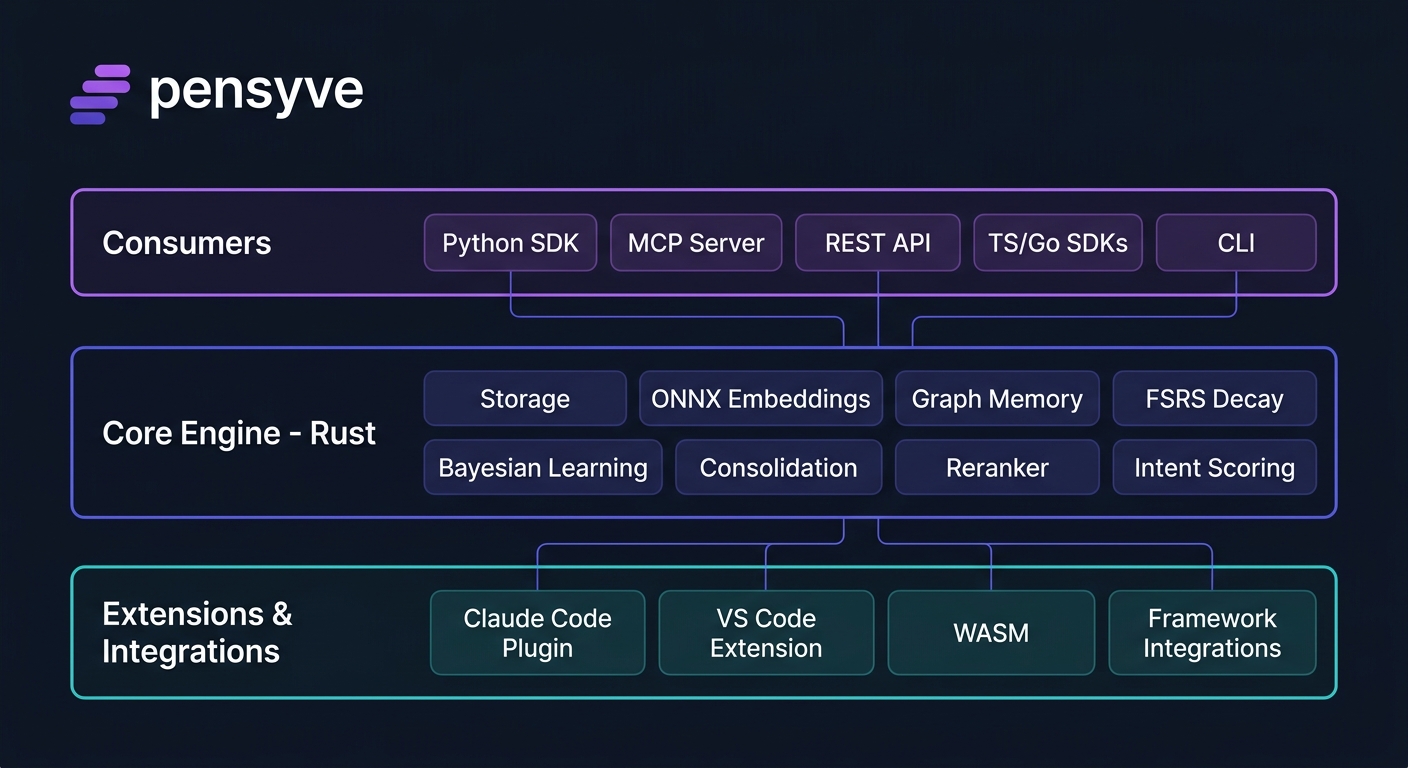
Namespace (isolation boundary)
  └── Entity (agent | user | team | tool)
        ├── Episodes (bounded interaction sequences)
        │     └── Messages (role + content)
        └── Memories
              ├── Episodic  — what happened (timestamped, multimodal content type)
              ├── Semantic  — what is known (SPO triples with temporal validity)
              └── Procedural — what works (action→outcome with Bayesian reliability)
- Embed query via ONNX (Alibaba-NLP/gte-base-en-v1.5, 768 dims)
- Classify intent — Question/Action/Recall/General (keyword heuristics)
- Vector search — cosine similarity against stored embeddings
- BM25 search — FTS5 lexical matching
- Graph traversal — petgraph BFS from query entity
- Fusion scoring — weighted sum of 8 signals (vector, BM25, graph, intent, recency, access, confidence, type boost)
- Cross-encoder reranking — BGE reranker on top-20 candidates
- FSRS reinforcement — retrieved memories get stability boost
pensyve/
├── pensyve-core/       Rust engine (rlib) — storage, embedding, retrieval, graph, decay, mesh, observability
├── pensyve-python/     Python SDK via PyO3 (cdylib)
├── pensyve-mcp/        MCP server binary (stdio, rmcp)
├── pensyve-cli/        CLI binary (clap)
├── pensyve-ts/         TypeScript SDK (bun) — timeout, retry, PensyveError
├── pensyve-go/         Go SDK — context-aware HTTP client
├── pensyve-wasm/       WASM build — standalone minimal in-memory Pensyve
├── pensyve_server/       Shared Python utilities — billing, extraction
├── integrations/       All integrations — IDE plugins, framework adapters, code harnesses
│   ├── claude-code/    Claude Code plugin (commands, skills, agents, hooks)
│   ├── vscode/         VS Code sidebar extension
│   ├── openclaw-plugin/ OpenClaw native memory plugin (TypeScript)
│   ├── opencode-plugin/ OpenCode native memory plugin (TypeScript)
│   ├── cursor/         Cursor MCP setup guide
│   ├── cline/          Cline MCP setup guide
│   ├── windsurf/       Windsurf MCP setup guide
│   ├── continue/       Continue MCP setup guide
│   ├── vscode-copilot/ VS Code Copilot Chat MCP setup guide
│   ├── langchain/      LangChain/LangGraph Python (PensyveStore + legacy PensyveMemory)
│   ├── langchain-ts/   LangChain.js/LangGraph.js TypeScript (PensyveStore)
│   ├── crewai/         CrewAI (PensyveStorage + standalone PensyveCrewMemory)
│   └── autogen/        Microsoft AutoGen multi-agent memory
├── tests/python/       Python integration tests
├── benchmarks/         LongMemEval_S evaluation + weight tuning
├── website/            Astro + Tailwind static site for pensyve.com
└── docs/               Architecture, roadmap, design specs, implementation plans
# Install dependencies (creates .venv automatically)
uv sync --extra dev

# Build the native Python module (required before running any Python code)
uv run maturin develop --release -m pensyve-python/Cargo.toml

# Verify the module loads
uv run python -c "import pensyve; print(pensyve.__version__)"
Note: The
pensyvePython package is a native Rust extension built with PyO3. You must runuv run maturin developbeforepytestor any Python import ofpensyve, otherwise you will getModuleNotFoundError: No module named 'pensyve'.
make build      # Compile Rust + build PyO3 module
make test       # Run all tests (Rust + Python)
make lint       # clippy + ruff + pyright
make format     # cargo fmt + ruff format
make check      # lint + test (CI gate)
To run test suites individually:
cargo test --workspace                                       # Rust tests
uv run maturin develop --release -m pensyve-python/Cargo.toml  # Build PyO3 module first
uv run pytest tests/python/ -v                               # Python tests
cd pensyve-ts && bun test                                    # TypeScript tests
cd pensyve-go && go test ./... # Go testscd pensyve-ts && bun test # TypeScript (38 tests)
cd pensyve-go && go test ./... # Go (17 tests)
cd pensyve-wasm && cargo check # WASM (standalone)# Run LongMemEval_S evaluation (builtin dataset: 87.5% baseline)
python benchmarks/longmemeval/run.py --verbose
# Run weight optimization
python benchmarks/tuning/optimize.py --maxiter 50| What you need | Pensyve | Mem0 | Zep | Honcho |
|---|---|---|---|---|
| Works offline, no cloud required | Yes — SQLite, runs on your laptop | No — cloud API | No — requires server | No — cloud API |
| Agent learns from outcomes | Yes — procedural memory tracks what works | No | No | No |
| Finds memories by meaning | 8-signal fusion (vector + BM25 + graph + intent + 4 more) | Vector only | Vector + temporal | Vector only |
| Memories fade naturally | FSRS forgetting curve with reinforcement | No — manual cleanup | Basic TTL | No |
| Multi-turn conversation capture | Episodes with outcome tracking | Basic | Yes | Yes |
| Framework agnostic | Python, TypeScript, Go, MCP, REST, CLI | Python SDK | Python/JS | Python |
| Claude Code / Cursor / VS Code | Native plugins + MCP | No | No | No |
| Production-ready at scale | Postgres + pgvector (feature-gated) | Yes | Yes | Yes |
| Open source | Apache 2.0 | Yes | Partial | Yes |