



llm.rb is a Ruby-centric toolkit for building real LLM-powered systems — where LLMs are part of your architecture, not just API calls. It gives you explicit control over contexts, tools, concurrency, and providers, so you can compose reliable, production-ready workflows without hidden abstractions.
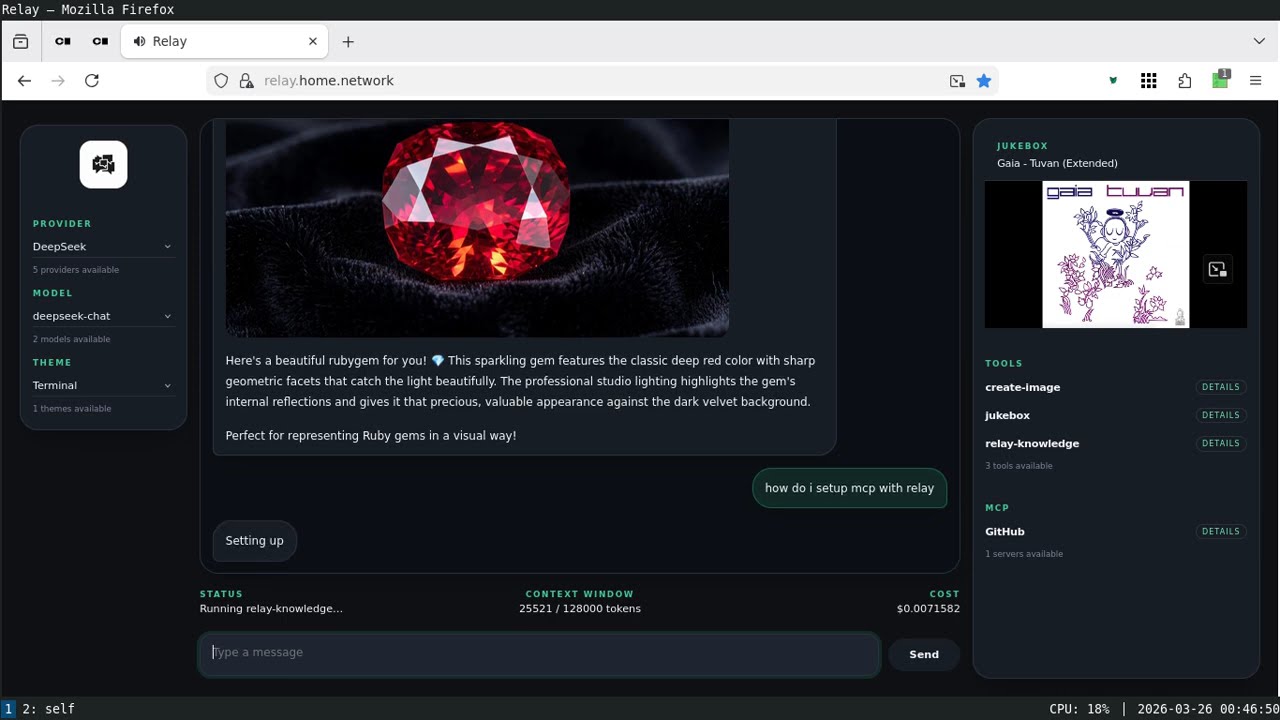
Built for engineers who want to understand and control their LLM systems. No frameworks, no hidden magic — just composable primitives for building real applications, from scripts to full systems like Relay.
Jump to Quick start, discover its capabilities, read about its architecture or watch the Screencast for a deep dive into the design and capabilities of llm.rb.
Most LLM libraries stop at requests and responses.
llm.rb is built around the state and execution model around them:
- Contexts are central
They hold history, tools, schema, usage, cost, persistence, and execution state. - Tool execution is explicit
Run local, provider-native, and MCP tools sequentially or concurrently with threads, fibers, or async tasks. - Run tools while streaming
Start tool work while a response is still streaming instead of waiting for the turn to finish. - HTTP MCP can reuse connections
Opt into persistent HTTP pooling for repeated remote MCP tool calls withpersist!. - One API across providers and capabilities
The same model covers chat, files, images, audio, embeddings, vector stores, and more. - Thread-safe where it matters
Providers are shareable, while contexts stay isolated and stateful. - Local metadata, fewer extra API calls
A built-in registry provides model capabilities, limits, pricing, and cost estimation. - Stdlib-only by default
llm.rb runs on the Ruby standard library by default, with providers, optional features, and the model registry loaded only when you use them.
llm.rb is built in layers, each providing explicit control:
┌─────────────────────────────────────────┐
│          Your Application               │
├─────────────────────────────────────────┤
│         Contexts & Agents               │ ← Stateful workflows
├─────────────────────────────────────────┤
│           Tools & Functions             │ ← Concurrent execution
├─────────────────────────────────────────┤
│   Unified Provider API (OpenAI, etc.)   │ ← Provider abstraction
├─────────────────────────────────────────┤
│      HTTP, JSON, Thread Safety          │ ← Infrastructure
└─────────────────────────────────────────┘
- Thread-safe providers -
LLM::Providerinstances are safe to share across threads - Thread-local contexts -
LLM::Contextshould generally be kept thread-local - Lazy loading - Providers, optional features, and the model registry load on demand
- JSON adapter system - Swap JSON libraries (JSON/Oj/Yajl) for performance
- Registry system - Local metadata for model capabilities, limits, and pricing
- Provider adaptation - Normalizes differences between OpenAI, Anthropic, Google, and other providers
- Structured tool execution - Errors are captured and returned as data, not raised unpredictably
- Function vs Tool APIs - Choose between class-based tools and closure-based functions
llm.rb provides a complete set of primitives for building LLM-powered systems:
- Chat & Contexts — stateless and stateful interactions with persistence
- Streaming — real-time responses across providers
- Reasoning Support — full stream, message, and response support when providers expose reasoning
- Tool Calling — define and execute functions with automatic orchestration
- Concurrent Execution — threads, async tasks, and fibers
- Agents — reusable, preconfigured assistants with tool auto-execution
- Structured Outputs — JSON schema-based responses
- MCP Support — integrate external tool servers dynamically over stdio or HTTP
- Multimodal Inputs — text, images, audio, documents, URLs
- Audio — text-to-speech, transcription, translation
- Images — generation and editing
- Files API — upload and reference files in prompts
- Embeddings — vector generation for search and RAG
- Vector Stores — OpenAI-based retrieval workflows
- Cost Tracking — estimate usage without API calls
- Observability — tracing, logging, telemetry
- Model Registry — local metadata for capabilities, limits, pricing
llm.rb provides explicit concurrency control for tool execution. The
wait(:thread) method spawns each pending function in its own thread and waits
for all to complete. You can also use :fiber for cooperative multitasking or
:task for async/await patterns (requires the async gem). The context
automatically collects all results and reports them back to the LLM in a
single turn, maintaining conversation flow while parallelizing independent
operations:
#!/usr/bin/env ruby
require "llm"

llm = LLM.openai(key: ENV["KEY"])
ctx = LLM::Context.new(llm, stream: $stdout, tools: [FetchWeather, FetchNews, FetchStock])

# Execute multiple independent tools concurrently
ctx.talk("Summarize the weather, headlines, and stock price.")
ctx.talk(ctx.functions.wait(:thread)) while ctx.functions.any?llm.rb integrates with the Model Context Protocol (MCP) to dynamically discover
and use tools from external servers. This example starts a filesystem MCP
server over stdio and makes its tools available to a context, enabling the LLM
to interact with the local file system through a standardized interface.
Use LLM::MCP.stdio or LLM::MCP.http when you want to make the transport
explicit. Like LLM::Context, an MCP client is stateful and should remain
isolated to a single thread:
#!/usr/bin/env ruby
require "llm"

llm = LLM.openai(key: ENV["KEY"])
mcp = LLM::MCP.stdio(argv: ["npx", "-y", "@modelcontextprotocol/server-filesystem", Dir.pwd])

begin
  mcp.start
  ctx = LLM::Context.new(llm, stream: $stdout, tools: mcp.tools)
  ctx.talk("List the directories in this project.")
  ctx.talk(ctx.functions.call) while ctx.functions.any?
ensure
  mcp.stop
end
You can also connect to an MCP server over HTTP. This is useful when the
server already runs remotely and exposes MCP through a URL instead of a local
process. If you expect repeated tool calls, use persist! to reuse a
process-wide HTTP connection pool. This requires the optional
net-http-persistent gem:
#!/usr/bin/env ruby
require "llm"

llm = LLM.openai(key: ENV["KEY"])
mcp = LLM::MCP.http(
  url: "https://api.githubcopilot.com/mcp/",
  headers: {"Authorization" => "Bearer #{ENV.fetch("GITHUB_PAT")}"}
).persist!

begin
  mcp.start
  ctx = LLM::Context.new(llm, stream: $stdout, tools: mcp.tools)
  ctx.talk("List the available GitHub MCP toolsets.")
  ctx.talk(ctx.functions.call) while ctx.functions.any?
ensure
  mcp.stop
endAt the simplest level, any object that implements #<< can receive visible
output as it arrives. This works with $stdout, StringIO, files, sockets,
and other Ruby IO-style objects:
#!/usr/bin/env ruby
require "llm"

llm = LLM.openai(key: ENV["KEY"])
ctx = LLM::Context.new(llm, stream: $stdout)
loop do
  print "> "
  ctx.talk(STDIN.gets || break)
  puts
endllm.rb also supports the LLM::Stream interface for
structured streaming events:
on_contentfor visible assistant outputon_reasoning_contentfor separate reasoning outputon_tool_callfor streamed tool-call notifications
Subclass LLM::Stream when you want features like
queue and wait, or implement the same methods on your own object. Keep these
callbacks fast: they run inline with the parser.
on_tool_call lets tools start before the model finishes its turn, for
example with tool.spawn(:thread), tool.spawn(:fiber), or
tool.spawn(:task).
If a stream cannot execute a tool, error is an LLM::Function::Return that
communicates the failure back to the LLM. That lets the tool-call path recover
and keeps the session alive. It also leaves control in the callback: it can
send error, spawn the tool when error == nil, or handle the situation
however it sees fit.
In normal use this should be rare, since on_tool_call is usually called with
a resolved tool and error == nil. To resolve a tool call, the tool must be
found in LLM::Function.registry. That covers LLM::Tool subclasses,
including MCP tools, but not LLM.function closures, which are excluded
because they may be bound to local state:
#!/usr/bin/env ruby
require "llm"
# Assume `System < LLM::Tool` is already defined.

class Stream < LLM::Stream
  attr_reader :content, :reasoning_content

  def initialize
    @content = +""
    @reasoning_content = +""
  end

  def on_content(content)
    @content << content
    print content
  end

  def on_reasoning_content(content)
    @reasoning_content << content
  end

  def on_tool_call(tool, error)
    queue << (error || tool.spawn(:thread))
  end
end

llm = LLM.openai(key: ENV["KEY"])
stream = Stream.new
ctx = LLM::Context.new(llm, stream:, tools: [System])

ctx.talk("Run `date` and `uname -a`.")
while ctx.functions.any?
  ctx.talk(stream.wait(:thread))
endTools in llm.rb can be defined as classes inheriting from LLM::Tool or as
closures using LLM.function. When the LLM requests a tool call, the context
stores Function objects in ctx.functions. The call() method executes all
pending functions and returns their results to the LLM. Tools describe
structured parameters with JSON Schema and adapt those definitions to each
provider's tool-calling format (OpenAI, Anthropic, Google, etc.):
#!/usr/bin/env ruby
require "llm"

class System < LLM::Tool
  name "system"
  description "Run a shell command"
  param :command, String, "Command to execute", required: true

  def call(command:)
    {success: system(command)}
  end
end

llm = LLM.openai(key: ENV["KEY"])
ctx = LLM::Context.new(llm, stream: $stdout, tools: [System])
ctx.talk("Run `date`.")
ctx.talk(ctx.functions.call) while ctx.functions.any?The LLM::Schema system lets you define JSON schemas for structured outputs.
Schemas can be defined as classes with property declarations or built
programmatically using a fluent interface. When you pass a schema to a context,
llm.rb adapts it into the provider's structured-output format when that
provider supports one. The content! method then parses the assistant's JSON
response into a Ruby object:
#!/usr/bin/env ruby
require "llm"
require "pp"

class Report < LLM::Schema
  property :category, Enum["performance", "security", "outage"], "Report category", required: true
  property :summary, String, "Short summary", required: true
  property :impact, OneOf[String, Integer], "Primary impact, as text or a count", required: true
  property :services, Array[String], "Impacted services", required: true
  property :timestamp, String, "When it happened", optional: true
end

llm = LLM.openai(key: ENV["KEY"])
ctx = LLM::Context.new(llm, schema: Report)
res = ctx.talk("Structure this report: 'Database latency spiked at 10:42 UTC, causing 5% request timeouts for 12 minutes.'")
pp res.content!

# {
#   "category" => "performance",
#   "summary" => "Database latency spiked, causing 5% request timeouts for 12 minutes.",
#   "impact" => "5% request timeouts",
#   "services" => ["Database"],
#   "timestamp" => "2024-06-05T10:42:00Z"
# }llm.rb supports multiple LLM providers with a unified API. All providers share the same context, tool, and concurrency interfaces, making it easy to switch between cloud and local models:
- OpenAI (
LLM.openai) - Anthropic (
LLM.anthropic) - Google (
LLM.google) - DeepSeek (
LLM.deepseek) - xAI (
LLM.xai) - zAI (
LLM.zai) - Ollama (
LLM.ollama) - Llama.cpp (
LLM.llamacpp)
llm.rb is designed for production use from the ground up:
- Thread-safe providers - Share
LLM::Providerinstances across your application - Thread-local contexts - Keep
LLM::Contextinstances thread-local for state isolation - Cost tracking - Know your spend before the bill arrives
- Observability - Built-in tracing with OpenTelemetry support
- Persistence - Save and restore contexts across processes
- Performance - Swap JSON adapters and enable HTTP connection pooling
- Error handling - Structured errors, not unpredictable exceptions
llm.rb includes built-in tracers for local logging, OpenTelemetry, and LangSmith. Assign a tracer to a provider and all context requests and tool calls made through that provider will be instrumented. Tracers are local to the current fiber, so the same provider can use different tracers in different concurrent tasks without interfering with each other.
Use the logger tracer when you want structured logs through Ruby's standard library:
#!/usr/bin/env ruby
require "llm"

llm = LLM.openai(key: ENV["KEY"])
llm.tracer = LLM::Tracer::Logger.new(llm, io: $stdout)

ctx = LLM::Context.new(llm)
ctx.talk("Hello")
Use the telemetry tracer when you want OpenTelemetry spans. This requires the
opentelemetry-sdk gem, and exporters such as OTLP can be added separately:
#!/usr/bin/env ruby
require "llm"

llm = LLM.openai(key: ENV["KEY"])
llm.tracer = LLM::Tracer::Telemetry.new(llm)

ctx = LLM::Context.new(llm)
ctx.talk("Hello")
pp llm.tracer.spans
Use the LangSmith tracer when you want LangSmith-compatible metadata and trace grouping on top of the telemetry tracer:
#!/usr/bin/env ruby
require "llm"

llm = LLM.openai(key: ENV["KEY"])
llm.tracer = LLM::Tracer::Langsmith.new(
  llm,
  metadata: {env: "dev"},
  tags: ["chatbot"]
)

ctx = LLM::Context.new(llm)
ctx.talk("Hello")llm.rb uses Ruby's Monitor class to ensure thread safety at the provider
level, allowing you to share a single provider instance across multiple threads
while maintaining state isolation through thread-local contexts. This design
enables efficient resource sharing while preventing race conditions in
concurrent applications:
#!/usr/bin/env ruby
require "llm"

# Thread-safe providers - create once, use everywhere
llm = LLM.openai(key: ENV["KEY"])

# Each thread should have its own context for state isolation
Thread.new do
  ctx = LLM::Context.new(llm)  # Thread-local context
  ctx.talk("Hello from thread 1")
end

Thread.new do
  ctx = LLM::Context.new(llm)  # Thread-local context
  ctx.talk("Hello from thread 2")
endllm.rb's JSON adapter system lets you swap JSON libraries for better
performance in high-throughput applications. The library supports stdlib JSON,
Oj, and Yajl, with Oj typically offering the best performance. Additionally,
you can enable HTTP connection pooling using the optional net-http-persistent
gem to reduce connection overhead in production environments:
#!/usr/bin/env ruby
require "llm"

# Swap JSON libraries for better performance
LLM.json = :oj  # Use Oj for faster JSON parsing

# Enable HTTP connection pooling for high-throughput applications
llm = LLM.openai(key: ENV["KEY"]).persist! # Uses net-http-persistent when availablellm.rb includes a local model registry that provides metadata about model capabilities, pricing, and limits without requiring API calls. The registry is shipped with the gem and sourced from https://models.dev, giving you access to up-to-date information about context windows, token costs, and supported modalities for each provider:
#!/usr/bin/env ruby
require "llm"

# Access model metadata, capabilities, and pricing
registry = LLM.registry_for(:openai)
model_info = registry.limit(model: "gpt-4.1")
puts "Context window: #{model_info.context} tokens"
puts "Cost: $#{model_info.cost.input}/1M input tokens"llm.rb also supports OpenAI's Responses API through LLM::Context with
mode: :responses. The important switch is store:. With store: false, the
Responses API stays stateless while still using the Responses endpoint, which
is useful for models or features that are only available through the Responses
API. With store: true, OpenAI can keep
response state server-side and reduce how much conversation state needs to be
sent on each turn:
#!/usr/bin/env ruby
require "llm"

llm = LLM.openai(key: ENV["KEY"])
ctx = LLM::Context.new(llm, mode: :responses, store: false)

ctx.talk("Your task is to answer the user's questions", role: :developer)
res = ctx.talk("What is the capital of France?")
puts res.contentContexts can be serialized and restored across process boundaries. This makes it possible to persist conversation state in a file, database, or queue and resume work later:
#!/usr/bin/env ruby
require "llm"

llm = LLM.openai(key: ENV["KEY"])
ctx = LLM::Context.new(llm)
ctx.talk("Hello")
ctx.talk("Remember that my favorite language is Ruby")
ctx.save(path: "context.json")

restored = LLM::Context.new(llm)
restored.restore(path: "context.json")
res = restored.talk("What is my favorite language?")
puts res.content
Agents in llm.rb are reusable, preconfigured assistants that automatically execute tool calls and maintain conversation state. Unlike contexts which require manual tool execution, agents automatically handle the tool call loop, making them ideal for autonomous workflows where you want the LLM to independently use available tools to accomplish tasks:
#!/usr/bin/env ruby
require "llm"

class SystemAdmin < LLM::Agent
  model "gpt-4.1"
  instructions "You are a Linux system admin"
  tools Shell
  schema Result
end

llm = LLM.openai(key: ENV["KEY"])
agent = SystemAdmin.new(llm)
res = agent.talk("Run 'date'")llm.rb provides built-in cost estimation that works without making additional API calls. The cost tracking system uses the local model registry to calculate estimated costs based on token usage, giving you visibility into spending before bills arrive. This is particularly useful for monitoring usage in production applications and setting budget alerts:
#!/usr/bin/env ruby
require "llm"

llm = LLM.openai(key: ENV["KEY"])
ctx = LLM::Context.new(llm)
ctx.talk "Hello"
puts "Estimated cost so far: $#{ctx.cost}"
ctx.talk "Tell me a joke"
puts "Estimated cost so far: $#{ctx.cost}"Contexts provide helpers for composing multimodal prompts from URLs, local files, and provider-managed remote files. These tagged objects let providers adapt the input into the format they expect:
#!/usr/bin/env ruby
require "llm"

llm = LLM.openai(key: ENV["KEY"])
ctx = LLM::Context.new(llm)

res = ctx.talk ["Describe this image", ctx.image_url("https://example.com/cat.jpg")]
puts res.contentllm.rb supports OpenAI's audio API for text-to-speech generation, allowing you to create speech from text with configurable voices and output formats. The audio API returns binary audio data that can be streamed directly to files or other IO objects, enabling integration with multimedia applications:
#!/usr/bin/env ruby
require "llm"

llm = LLM.openai(key: ENV["KEY"])
res = llm.audio.create_speech(input: "Hello world")
IO.copy_stream res.audio, File.join(Dir.home, "hello.mp3")llm.rb provides access to OpenAI's DALL-E image generation API through a unified interface. The API supports multiple response formats including base64-encoded images and temporary URLs, with automatic handling of binary data streaming for efficient file operations:
#!/usr/bin/env ruby
require "llm"

llm = LLM.openai(key: ENV["KEY"])
res = llm.images.create(prompt: "a dog on a rocket to the moon")
IO.copy_stream res.images[0], File.join(Dir.home, "dogonrocket.png")llm.rb's embedding API generates vector representations of text for semantic search and retrieval-augmented generation (RAG) workflows. The API supports batch processing of multiple inputs and returns normalized vectors suitable for vector similarity operations, with consistent dimensionality across providers:
#!/usr/bin/env ruby
require "llm"

llm = LLM.openai(key: ENV["KEY"])
res = llm.embed(["programming is fun", "ruby is a programming language", "sushi is art"])
puts res.class
puts res.embeddings.size
puts res.embeddings[0].size

# LLM::Response
# 3
# 1536See how these pieces come together in a complete application architecture with Relay, a production-ready LLM application built on llm.rb that demonstrates:
- Context management across requests
- Tool composition and execution
- Concurrent workflows
- Cost tracking and observability
- Production deployment patterns
Watch the screencast:


gem install llm.rb