Based on the KLHK (Ministry of Environment and Forestry) data, Indonesia has produced 67.8 million tons of waste in 2020. 37.3% of which comes from household activities. Unfortunately, a qualified waste management capability does not follow the high amount of waste. The Plastic Bank stated that of 7.8 million tons of waste produced by Indonesia, 4.9 million tons did not receive good management until they reached the landfill. We believe that this problem occurs because most Indonesians do not know and do not care about waste classification. Therefore, we want to create an application that raises users' awareness about waste classification and helps those confused about determining the type of waste. In addition to that, users can also funnel the garbage to the appropriate vendor through our application.
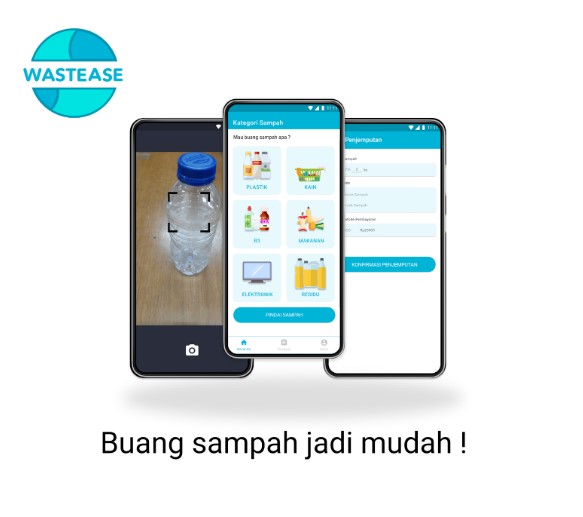
There are already applications for managing and distributing waste in Indonesia. With those apps as a reference, we tried to design a similar application by emphasizing the unique aspects of sorting and channeling types of residential waste. We want to make an application that can detect six types of residential waste by scanning the camera on a smartphone: plastics, textiles, hazardous wastes (B3), food wastes, consumer electronics, and residue. After that, our application will provide several alternative waste distributions to the appropriate parties to facilitate waste management. For example, through special drop-box facilities for clothing waste, transportation services for plastic waste, and so on. It also connects users with the nearest long-distance transportation service to deliver their waste to the vendor.
- Machine Learning: Compiling data from several sources, augmenting the images for training process, building data pipelines to serve the models, developing models with Tensorflow.
- Android: Developing and deploying an application that works on android-based mobile phones. This app has several functionalities such as enabling users to scan various waste through their mobile phone camera, order pick-up service to funnel their garbage, etc.
- Cloud: Using NodeJS and Google Cloud Platform to build and deploy API.
We are interested in working on this project because the Indonesians are not yet aware of waste sorting and management. We conducted this project to help the community manage and distribute waste, especially household waste, with the feature of identifying the type of waste using the user's smartphone camera. We plan to cooperate with local waste management agencies to enable users to place orders for garbage pick-up at home. We believe that we can simplify and improve waste management in Indonesia by sorting and separating waste from homes and then channeling it to the appropriate management agency.