
Important
RFDT uses RayD, our self-developed differentiable ray-tracing core, as its ray-tracing backend.
If you are looking for the Mitsuba version, please see the mitsuba branch.
Note
This is a conceptual demo with minimal implementation. The full simulator is coming soon on WiTwin.AI.
Xingyu Chen1, Xinyu Zhang1, Kai Zheng1, Xinmin Fang2, Tzu-Mao Li1, Chris Xiaoxuan Lu3, Zhengxiong Li2
1University of California, San Diego 2University of Colorado Denver 3University College London
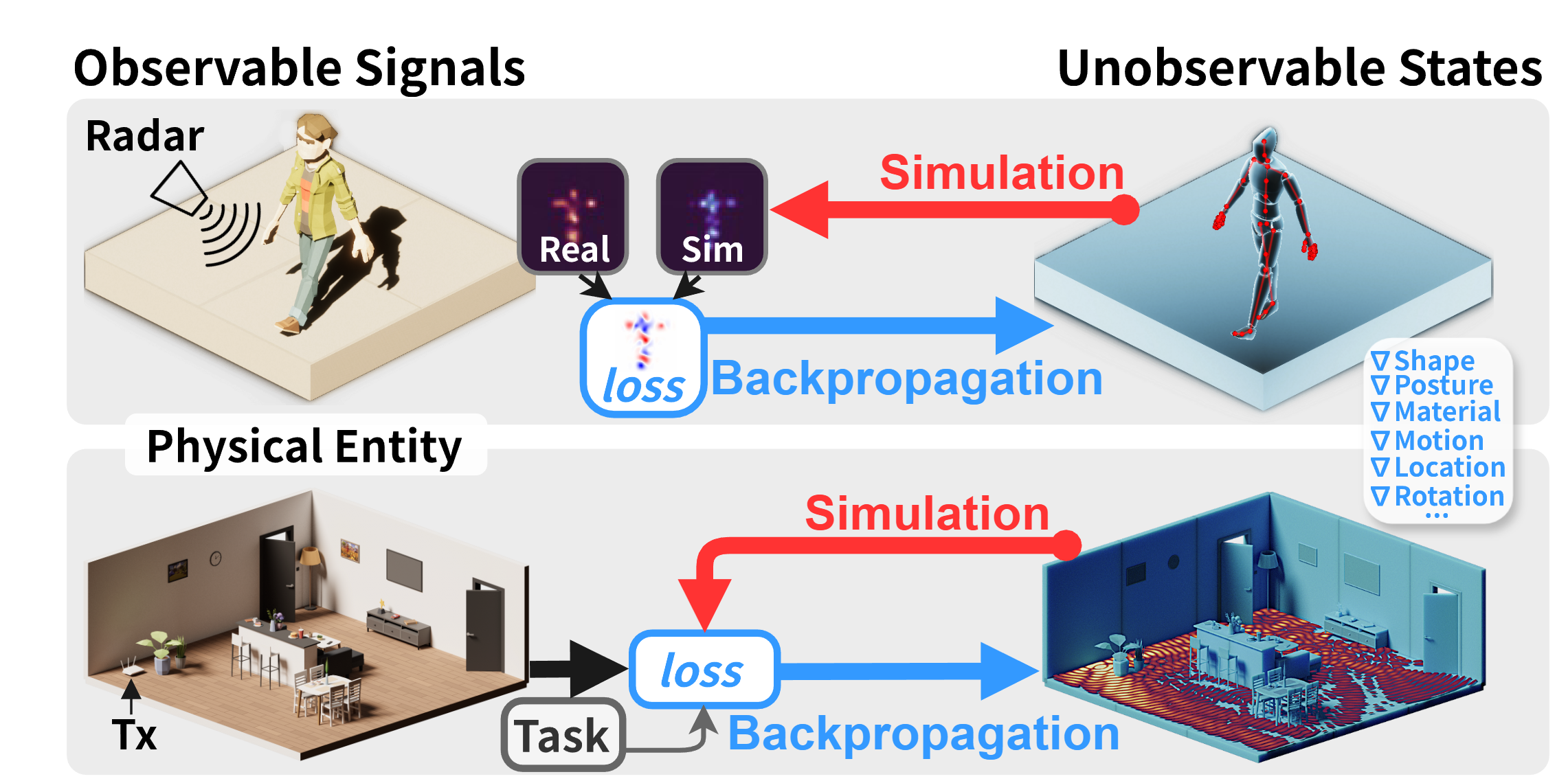
RFDT constructs digital twins by solving the inverse problem of RF simulation. Top: 3D reconstruction through radar simulation. Bottom: Communication system optimization through RF scene rendering.
Digital twins (DTs) are virtual replicas of physical scenes that transform the design and evaluation of wireless systems. Previous RF simulators are non-differentiable, limiting their potential for DT construction. We present RFDT, a physically-based differentiable RF simulation framework that enables gradient-based interaction between virtual and physical worlds. RFDT overcomes discontinuities in RF ray tracing using a physically grounded edge-diffraction transition function, and mitigates non-convexity from Fourier-domain processing through a signal-domain transform surrogate. Our framework demonstrates the ability to accurately reconstruct digital twins from real RF measurements and supports augmentation of downstream applications including ML-based RF sensing and communication system optimization.
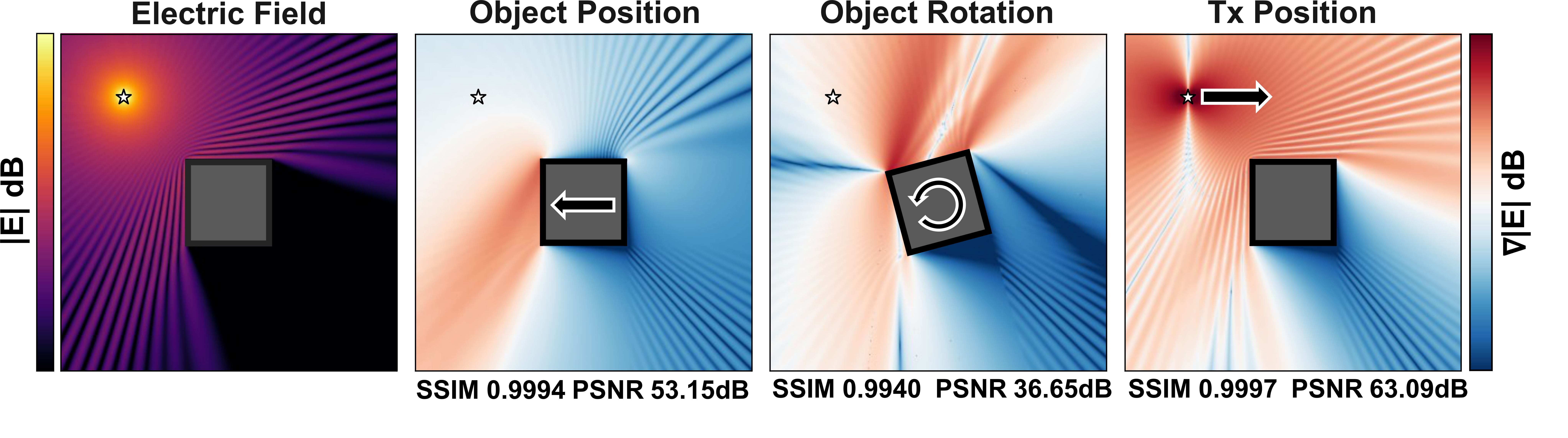
Gradients w.r.t. different scene parameters (object position, rotation, and Tx position), with finite difference as ground truth. RFDT achieves SSIM up to 0.9997 and PSNR up to 63.09 dB.
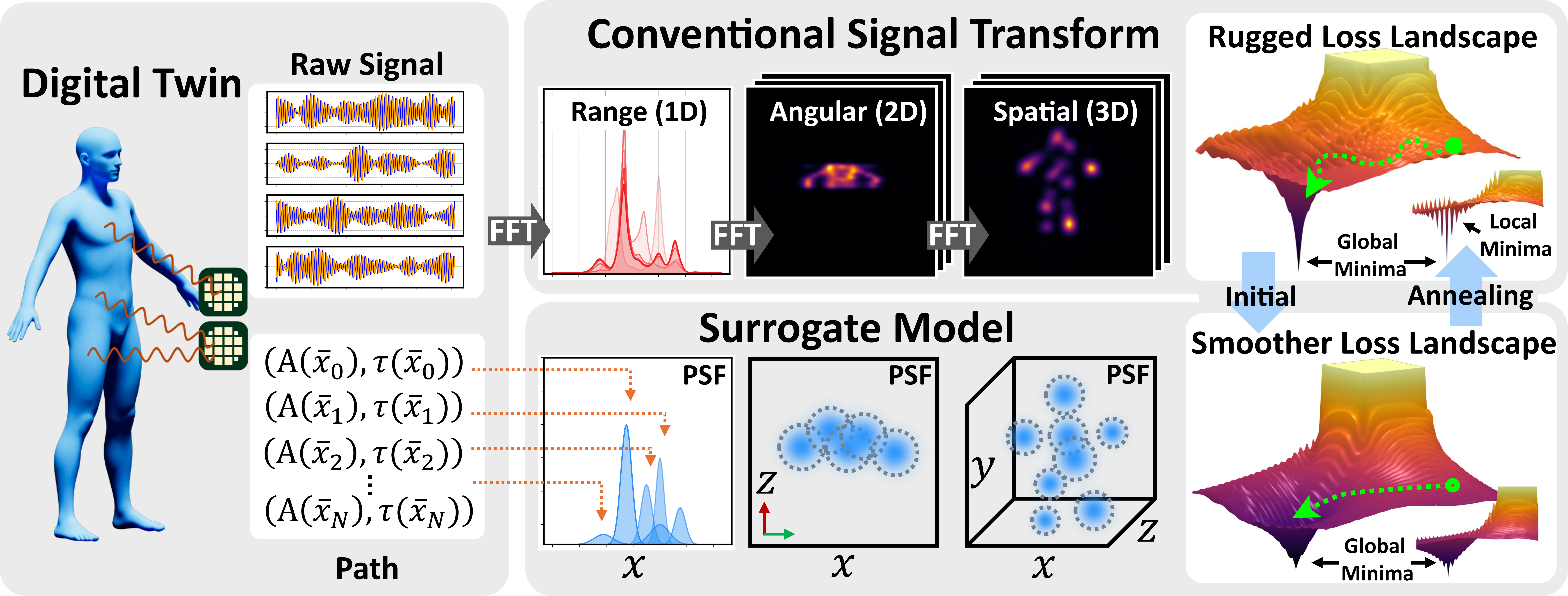
Signal-domain transform surrogate. By replacing FFT-domain representations with smooth surrogates (PSF, Dirichlet), the optimization landscape becomes convex-like, enabling reliable convergence.
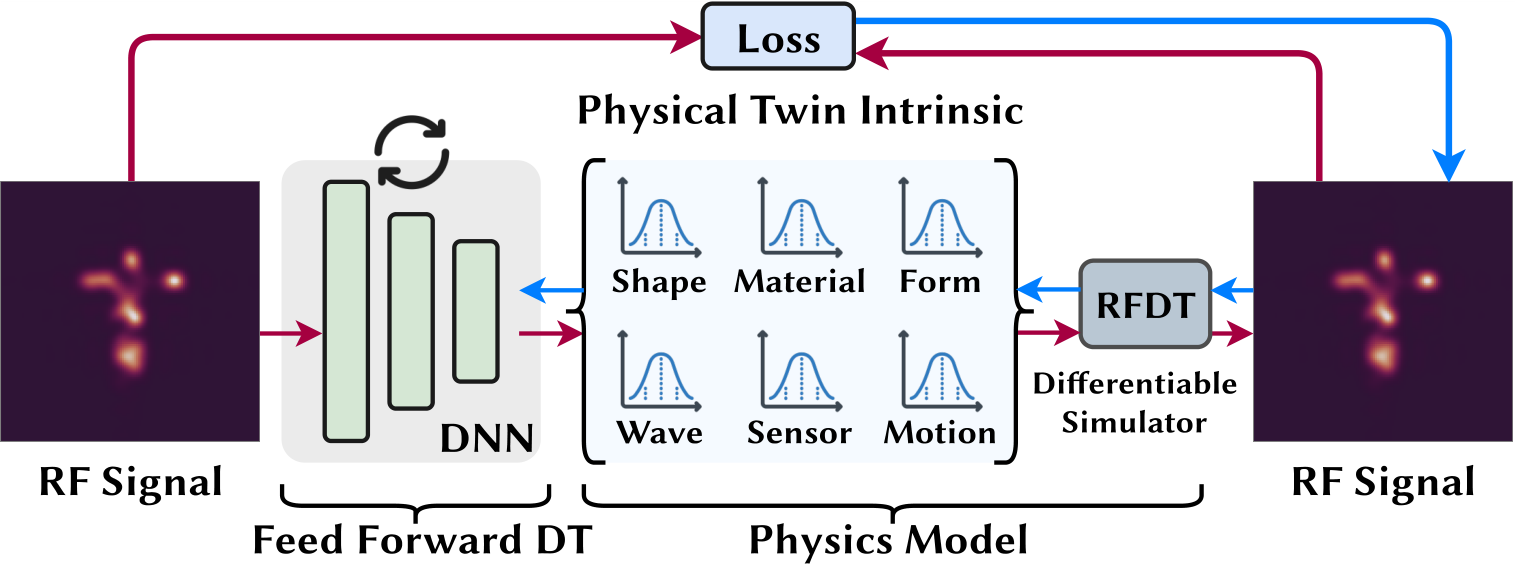
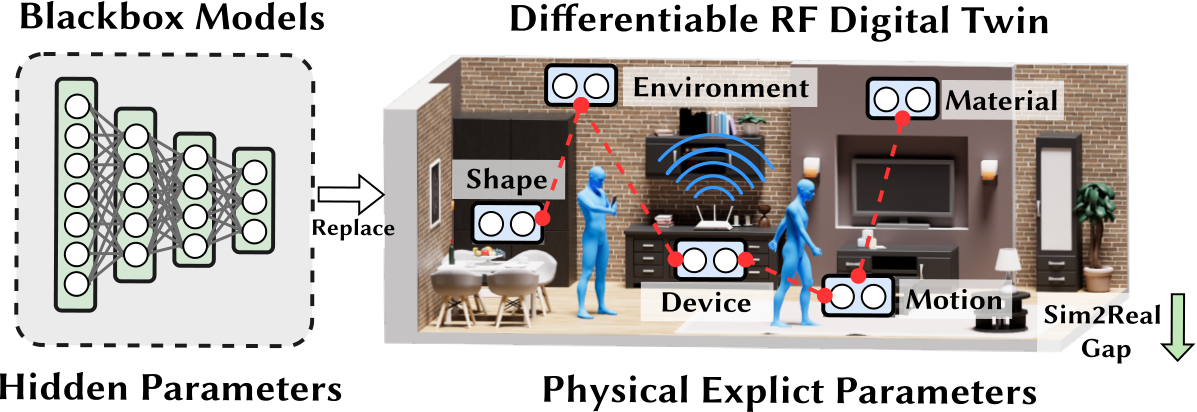
- Enhancing neural networks. RFDT acts as a physics-informed regularizer that backpropagates through the simulation loop, enabling test-time adaptation of pre-trained models to unseen environments without any labeled data.
- Replacing neural networks. With fully differentiable scene parameterization, RFDT directly optimizes geometry, materials, and RF attributes end-to-end — achieving interpretable, physics-grounded solutions without black-box learned components.
This repository uses RayD as its ray-tracing backend, not Mitsuba. RayD is our self-developed differentiable ray-tracing core, and the current RFDT demo runs on top of RayD + DrJit.
conda activate witwin2
pip install -r requirements.txt
Requires Python 3.10+, a CUDA-capable GPU, and the RayD + DrJit runtime.
The current notebooks and scripts are validated against the witwin2 conda environment.
This demo includes 5 Jupyter notebooks that illustrate the core ideas of RFDT:
| Notebook | Description |
|---|---|
forward.ipynb |
Forward simulation — Computes the RF field distribution (LoS + reflection + diffraction) around a cube using mesh-based UTD ray tracing. A good starting point to understand the simulation pipeline. |
grad_position.ipynb |
Gradient w.r.t. object position — Computes ∂field/∂x via automatic differentiation (AD) and validates against finite differences (FD). |
grad_rotation.ipynb |
Gradient w.r.t. object rotation — Computes ∂field/∂θ via AD and validates against FD. |
grad_transmitter.ipynb |
Gradient w.r.t. transmitter position — Computes ∂field/∂tx via AD and validates against FD. |
optimize.ipynb |
Inverse optimization — Given a target RF field, jointly optimizes object position and rotation to reconstruct the scene. Demonstrates the full inverse rendering pipeline. |
@inproceedings{chen2026rfdt,
  title     = {Physically Accurate Differentiable Inverse Rendering
               for Radio Frequency Digital Twin},
  author    = {Chen, Xingyu and Zhang, Xinyu and Zheng, Kai and
               Fang, Xinmin and Li, Tzu-Mao and Lu, Chris Xiaoxuan
               and Li, Zhengxiong},
  booktitle = {Proceedings of the 32nd Annual International Conference
               on Mobile Computing and Networking (MobiCom)},
  year      = {2026},
  doi       = {10.1145/3795866.3796686},
  publisher = {ACM},
  address   = {Austin, TX, USA},
}