An automated, interactive pipeline for generating, cleaning, and ranking Hashcat rules using genetic algorithms, bloom filters, and multi-armed bandit optimization. Now includes RCR — a modern dark/light-themed GUI front-end for the full chain.


- Overview
- Features
- Requirements
- Installation
- Usage
- Pipeline Stages
- RCR GUI Reference
- Parameters Reference
- Output Files
- Example Workflow
- Troubleshooting
- License
This project automates the creation of high-quality Hashcat rules through a three-stage process:
- Rulest — Generates raw rules using token-stripping and genetic algorithms
- Concentrator — Cleans and deduplicates the rule set
- Ranker — Ranks rules by effectiveness using exhaustive or Multi-Armed Bandit (MAB) screening
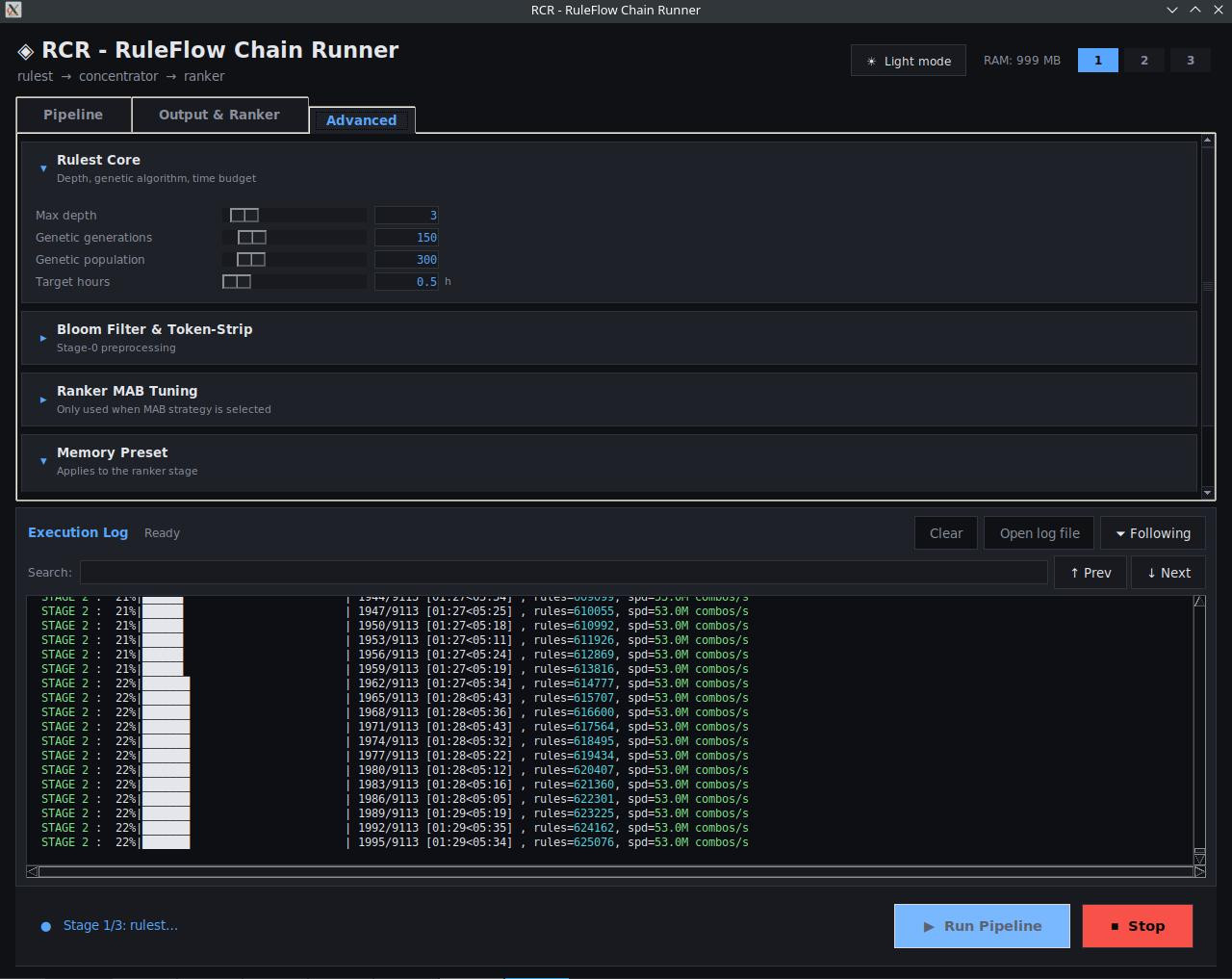
You can run the pipeline via the classic bash script (ruleflow.sh) or through RCR (rcr.py) — a Tkinter GUI that wraps the entire chain with real-time logs, memory monitoring, device scanning, selective stage execution, and one-click low-memory recovery.
- 4 Preset Modes: Maximum Quality, Balanced, Fast & Light, or Full Custom Control
- Genetic Algorithm: Evolves rules over multiple generations for optimal coverage
- Bloom Filter: Memory-efficient duplicate detection during rule generation
- MAB Ranking: Multi-Armed Bandit trials for statistically robust rule ranking
- Token Stripping: Automatic prefix/suffix tokenization for better rule derivation
- Interactive UI: Color-coded terminal prompts with sensible defaults (bash)
- Auto-Detection: Automatically locates concentrator output files
- Dark & Light themes — Toggle between a GitHub-inspired dark palette and a matching light palette at runtime; all widgets and log colors (including live ANSI output) re-theme instantly
- Selective stage execution — Run any combination of rulest / concentrator / ranker. Skipping rulest lets you feed in an external
.rulefile instead - Advanced concentrator filtering — Five independent post-processing filters (min occurrence, top-N cap, functional redundancy, inverse cut-off, hashcat rule validation) applied by concentrator.py itself, so the GUI and CLI always agree on the result
- Live execution log — Searchable (Prev/Next), with a follow/pause toggle; nothing is ever trimmed or dropped — the full run is kept on screen and mirrored to disk
- Memory monitor — Real-time RAM tracking (RCR + child processes) with automatic pressure warnings
- OpenCL device scanner — Detects GPUs without leaving the app
- OOM auto-recovery — Detects out-of-memory crashes and offers a one-click Low-Memory preset dialog
- Legacy vs MAB ranker — Choose exhaustive or adaptive ranking without editing commands, with in-app guidance on which fits your rule set
- Tabbed configuration — Pipeline, Output & Ranker, and Advanced settings

bash4.0+python3.8+hashcat(for rule testing/validation)tkinter8.6+ (for RCR GUI)psutil(optional, enables live RAM tracking in RCR)
The following scripts must be present in the working directory:
| Script | Purpose |
|---|---|
rulest_v2.py |
Rule generation engine |
concentrator.py |
Rule deduplication & cleaning |
ranker.py |
Rule ranking & evaluation |
RCR |
GUI front-end (optional) |
| File | Description | Required |
|---|---|---|
Base Wordlist |
Source words for rule generation | ✅ Yes (when running rulest or ranker) |
Target Wordlist |
Words to match against | ✅ Yes (when running rulest) |
Cracked Passwords |
Previously cracked hashes for ranking | ✅ Yes (when running ranker) |
External Rules File |
Pre-built .rule file |
Only if rulest is skipped |
# Clone or download the repository
git clone https://github.com/A113L/ruleflow.git
cd ruleflow

# Download the three core engines
wget https://raw.githubusercontent.com/A113L/rulest/refs/heads/main/rulest_v2.py
wget https://raw.githubusercontent.com/A113L/concentrator/refs/heads/main/concentrator.py
wget https://github.com/A113L/ranker/raw/refs/heads/main/ranker.py

# Download the GUI front-end (optional)
wget -O rcr.py https://github.com/A113L/ruleflow/raw/refs/heads/main/RCR

# Ensure Python scripts are executable
chmod +x rulest_v2.py concentrator.py ranker.py RCR

# Run the CLI pipeline
chmod +x ruleflow.sh
./ruleflow.sh

# Or launch the GUI
python RCRSimply run the script and follow the interactive prompts:
./ruleflow.shYou will be prompted for:
- Base wordlist path — Your source dictionary
- Target wordlist path — Words you want to crack
- Cracked passwords list — Previous cracks for ranking calibration
- Pipeline mode — Select preset or custom configuration
Launch the graphical runner:
python RCRWorkflow:
- Pipeline tab
- Step 0 — Select Stages to Run: tick/untick rulest, concentrator, and ranker independently. If rulest is unticked, an "External Rules Input" file picker appears — its
.rulefile is fed directly into whichever of concentrator/ranker remain enabled. - Step 1 — Input Files: base wordlist, target wordlist, cracked passwords, and output directory (only the files needed by your selected stages are required).
- Step 2 — Pipeline Mode: Maximum / Balanced / Fast / Custom.
- Step 0 — Select Stages to Run: tick/untick rulest, concentrator, and ranker independently. If rulest is unticked, an "External Rules Input" file picker appears — its
- Output & Ranker tab
- Step 3 — Concentrator Output: choose expanded (space-separated operators, easier to read/debug) vs compact (single line, slightly faster for hashcat to load) rule format.
- Step 3b — Advanced Filtering: five independent, optional post-processing filters, each passed straight through to
concentrator.py's own--filter-*flags so the GUI and CLI always produce identical results:- Minimum occurrence — drop rules that occur fewer than N times
- Maximum number of rules (top N) — keep only the top N rules
- Functional redundancy (RAM intensive) — keep one rule per functional signature
- Inverse mode — keep rules below the cut-off rank instead of above it
- Hashcat cleanup — validate rules against hashcat's own rule syntax, on CPU or GPU
- Step 4 — Ranker Strategy:
- Legacy (Exhaustive) — Recommended default. Tests every rule straight through; no bandit bookkeeping overhead, flatter RAM usage, maximum statistical accuracy. Usually the faster choice on balanced dictionaries.
- MAB (Multi-Armed Bandit) — Adaptive sampling that skips rules that look unpromising early. Pays off mainly on very large (10k+) or heavily imbalanced rule sets; on smaller/balanced ones it can be slower than Legacy due to sampling overhead.
- Advanced tab — Fine-tune genetic generations, bloom filter size, token-strip depth, MAB trials, and memory preset.
- Click ▶ Run Pipeline — Watch live logs, memory usage, and stage indicators.
GUI Tips:
- Click ⟳ Scan on the Pipeline tab to detect OpenCL devices.
- All five Step 3b filters are optional and independent — leave them all unchecked for concentrator's default behavior, or combine any subset.
- If a stage crashes with an OOM error, RCR will pop up a dialog to apply the Low-Memory preset automatically.
- Use the log search box (with Prev/Next) to find specific rules or errors in long runs.
- The execution log is never trimmed — every line from the run is kept on screen and mirrored to the log file on disk, so nothing is lost even on very long runs.
- Toggle ☀ Light mode / 🌙 Dark mode in the top-right corner at any time, including mid-run.
| Mode | Description | Use Case |
|---|---|---|
| 1) Maximum Quality | Highest accuracy, memory-intensive | Small target sets, maximum yield |
| 2) Balanced (Default) | Best trade-off between speed and quality | General purpose cracking |
| 3) Fast & Light | Quick results with reduced precision | Large-scale or time-constrained ops |
| 4) Custom | Full manual control over all parameters | Fine-tuning specific scenarios |
When selecting Maximum Quality or Custom mode, you can configure:
Max Depth— Rule derivation depth (1-31)Genetic Generations— Evolution iterations (20-1000)Genetic Population— Population size per generation (50-2000)Target Hours— Time budget for rule generation (0.5-12.0)
Bloom Filter Size— Memory allocation in MB (100-4000)Stage 0 Processes— Parallel workers (0 = auto)Token-Strip Prefix/Suffix— Max token lengths to strip (1-12)
Top-K Rules— Final rules to retain (1,000-100,000)MAB Screening Trials— Initial exploration rounds (1-30)MAB Final Trials— Final evaluation rounds (1-50)Memory Preset—low_memory/medium_memory/high_memory
Generates candidate rules using:
- Token Stripping: Removes common prefixes/suffixes to find core patterns
- Genetic Evolution: Breeds successful rules across generations
- Bloom Filtering: Prevents duplicate rule generation efficiently
python rulest_v2.py "$BASE_WORDLIST" "$TARGET_WORDLIST" \
    -o stage1_raw.rule \
    --max-depth 3 \
    --token-strip \
    --genetic \
    --genetic-generations 60 \
    --genetic-pop 200 \
    --target-hours 2.0 \
--bloom-mb 800Output: stage1_raw.rule
(This stage can be skipped entirely in the RCR GUI by unticking "1. rulest" and supplying an external .rule file instead.)
Cleans the raw rule set by:
- Removing duplicates
- Normalizing rule syntax
- Filtering invalid/ineffective rules
python concentrator.py -p stage1_raw.rule \
    --output_base_name stage2_cleaned \
--output-format lineOutput: stage2_cleaned*.rule (auto-detected)
Optional advanced filters (independent, can be combined; the RCR GUI's Step 3b checkboxes map directly to these):
python concentrator.py -p stage1_raw.rule \
    --output_base_name stage2_cleaned \
    --output-format line \
    --filter-min-occ 10 \
    --filter-max-rules 10000 \
    --filter-func-redundancy --yes \
    --filter-inverse 1000 \
--filter-hashcat-cleanup cpu| Flag | Effect |
|---|---|
--filter-min-occ N |
Drop rules occurring fewer than N times |
--filter-max-rules N |
Keep only the top N rules |
--filter-func-redundancy |
Keep one rule per functional signature (RAM intensive) |
--filter-inverse N |
Keep rules below the cut-off rank N instead of above it |
--filter-hashcat-cleanup {cpu,gpu} |
Validate rules against hashcat's rule syntax |
Ranks rules by empirical performance:
- Tests rules against cracked passwords
- Uses Legacy (exhaustive) or MAB algorithm for evaluation
- Selects top-K performing rules
# Legacy (recommended)
python ranker.py \
    -w "$BASE_WORDLIST" \
    -r "$CLEANED_RULE" \
    -c "$CRACKED_LIST" \
    -o stage3_ranking.csv \
    -k 75000 \
    --legacy \
    --preset medium_memory

# MAB (for very large / imbalanced sets)
python ranker.py \
    -w "$BASE_WORDLIST" \
    -r "$CLEANED_RULE" \
    -c "$CRACKED_LIST" \
    -o stage3_ranking.csv \
    -k 75000 \
    --mab-screening-trials 4 \
    --mab-final-trials 8 \
--preset medium_memoryOutput: stage3_ranking.csv, stage3_ranking_optimized.rule
| UI Element | Function |
|---|---|
| Stage Checkboxes | Enable/disable rulest, concentrator, and ranker independently for this run |
| External Rules Input | Appears only when rulest is disabled; supplies the .rule file that feeds the remaining stages |
| Mode Cards | One-click presets that auto-populate all advanced sliders |
| Advanced Filtering (Step 3b) | Five optional concentrator post-processing filters (min occurrence, top-N, functional redundancy, inverse, hashcat cleanup), each independently toggleable |
| Theme Toggle | Switches the whole UI (and log colors) between dark and light palettes |
| Device Scanner | Queries rulest_v2.py --list-devices and populates the GPU dropdown |
| Memory Label | Live RAM usage of RCR + child processes (requires psutil) |
| Log Panel | ANSI-aware colored output, search with Prev/Next, follow/pause toggle, never trimmed |
| Low-Memory Dialog | Auto-triggered on OOM detection; applies low_memory preset + reduced parameters |
| Stage Dots | Visual progress indicator for rulest → concentrator → ranker |
| Parameter | Maximum | Balanced | Fast |
|---|---|---|---|
RANKER_K |
100000 | 75000 | 50000 |
MAB_SCREENING |
5 | 4 | 3 |
MAB_FINAL |
10 | 8 | 5 |
PRESET |
medium_memory |
medium_memory |
medium_memory |
DEPTH |
10 | 6 | 3 |
GEN_GENERATIONS |
500 | 300 | 150 |
GENETIC_POP |
1000 | 600 | 300 |
TARGET_HOURS |
2.0 | 1.0 | 0.5 |
TOKEN_STRIP_PREFIX/SUFFIX |
10 | 6 | 3 |
| Parameter | Default |
|---|---|
DEPTH |
6 |
GEN_GENERATIONS |
300 |
GENETIC_POP |
600 |
TARGET_HOURS |
1.0 |
BLOOM_MB |
256 |
TOKEN_STRIP_MAX_PREFIX |
6 |
TOKEN_STRIP_MAX_SUFFIX |
6 |
RANKER_K |
75000 |
MEMORY_PRESET |
medium_memory |
| Stage | File | Description |
|---|---|---|
| 1 | stage1_raw.rule |
Raw generated rules (may contain duplicates) |
| 2 | stage2_cleaned*.rule |
Deduplicated, cleaned rule set |
| 3 | stage3_ranking.csv |
Ranked rules with performance metrics |
| 3 | stage3_ranking_optimized.rule |
Final optimized rules file for hashcat |
| — | rcr_run_YYYYMMDD_HHMMSS.log |
Full execution log (RCR only) |
# 1. Prepare your files
ls -la
# base.txt  target_wordlist.txt  cracked.txt  pipeline.sh rulest_v2.py concentrator.py ranker.py

# 2. Run the pipeline
./pipeline.sh

# === Step 1: Input Files ===
# Base wordlist path: base.txt
# Target wordlist path: target_wordlist.txt
# Cracked passwords list: cracked.txt

# === Step 2: Pipeline Mode ===
# Select mode (1-4) [2]: 2

# [1/3] Rulest... (genetic evolution running)
# [2/3] Concentrator... (cleaning rules)
# → Using: stage2_cleaned_line.rule
# [3/3] Ranker... (MAB optimization)

# 3. Use the final ranked rules with Hashcat
hashcat -m 0 -a 0 target_hashes.txt rockyou.txt -r stage3_ranking_optimized.rulepython rcr.py
# 1. (Optional) In "Step 0 — Select Stages to Run", untick any stage you want to skip
# 2. Select base.txt, target_wordlist.txt, cracked.txt (or an external .rule file if rulest is skipped)
# 3. Choose "Balanced" mode
# 4. On "Output & Ranker" tab, keep "Legacy (Exhaustive)" selected
# 5. Click "▶ Run Pipeline"
# 6. Copy stage3_ranking_optimized.rule to your hashcat command| Issue | Solution |
|---|---|
Base or Target wordlist not found! |
Verify file paths are correct and files exist |
Cracked list not found! |
Ranker requires a cracked passwords file. Generate one first |
Could not find Concentrator output! |
Check that concentrator.py generated stage2_cleaned*.rule |
Missing Rules File (GUI) |
You unticked rulest but didn't provide an external .rule file in "External Rules Input" |
No Stage Selected (GUI) |
At least one of rulest / concentrator / ranker must remain enabled |
| Out of Memory | Reduce BLOOM_MB, switch to low_memory preset, or use Fast mode |
| Slow performance | Use Fast & Light mode, reduce GEN_GENERATIONS, or lower TARGET_HOURS |
| RCR GUI won't start | Ensure tkinter is installed (sudo apt install python3-tk on Debian/Ubuntu) |
| RCR shows "n/a" for RAM | Install psutil (pip install psutil) for live memory tracking |
This project is licensed under the MIT License — see the LICENSE file for details.