- Optimized element trace tracking for elements with registered entities.
- A bloom-like filter for expediently discarding element traces during lookups.
- Discarding traces which are subsets of other traces is now more efficient.
- Considerably fewer traces are now generated during template execution.
- Dsl.Synthesis:
inject(ByteArray|KClass|Class)embeds the provided class into the template and adds it to the set of input classes. This method is primarily used to introduce new classes to the system model that are not originally part of the input classes. These could be shared code utility classes or any other classes that augment the functionality or structural understanding of the system. --statisticshas been updated with template deserialization time amd additional data on element traces.- Added repeatable
--columnoption to tree output. Valid columns identifiers:all,element-id,element-type,entity-type. -x/--debug-element-traceshows all traces associated with the requested element id. The element id can be obtained from--column element-idor--column all. Elements traverse parent and child nodes when associating entities with one another and when associatingproperty()data with entities.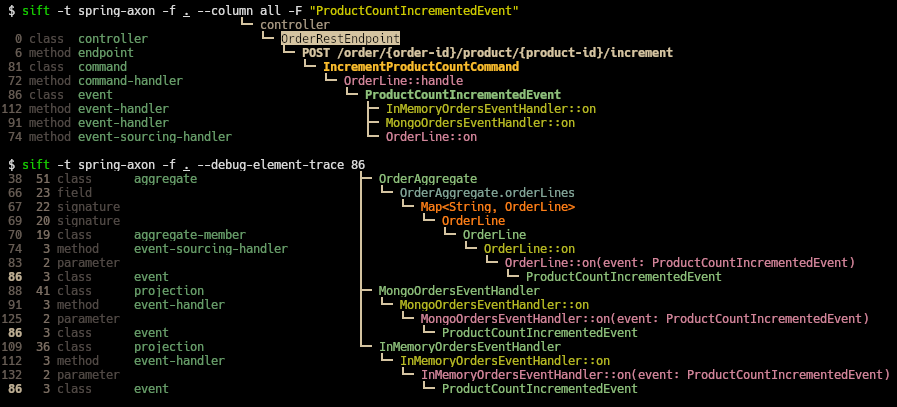
-X/--debug-inverse-tracereverses the element trace, used together with--debug-element-trace.
--dump-system-modelshort option name has been renamed to-D.
- DSL: fix
invocationsOf()discarding traces when multiple multiple elements invoke the same method element. - DSL:
methods {}now iterates methods for interfaces, even when there's no implementation. - Fix parsing the signature involving formal type parameters.
- Resolving inherited methods from interfaces failed to traverse the hierarchy beyond the first interface.
The tracking of element associations during template execution in Sift has undergone substantial performance
enhancements. Traced elements are now assigned unique integer identifiers, facilitating the replacement of
the previously tracked List<Element> with an int[]. This greatly improves cache locality, which in
turn, leads to much faster comparisons.
- StackOverflowError when resolving formal type parameters of generic enum.
- DSL:
readType()of signatures could omit the package name when constructing the type. - Exception during
--statisticson empty results.
The annotations scope enables working with annotations beyond reading top-level elements. It provides functions to traverse nested annotations and to initiate a class scope from types referenced by annotations.
annotations(filter: SiftType?) {} has been added to all scopes representing elements which can be annotated.
The filter parameter is optional and defaults to null, hence, if not specified, all annotations get returned.
Three unique functions are included within the annotations scope:
nested(element) {}: Iterates child annotations referenced by the specified element. Theelementparameter corresponds to the name of the annotation element which nested annotations are to be accessed.explodeTypes(element, synthesize) {}: Iterates over classes stored within a specific annotation element. The parameterelementrepresents the name of the annotation element to be processed.synthesizeis an optional parameter, defaulting tofalse. When set totrue, missing types are stubbed based on those stored within the annotation element.synthesizeis useful for stubbing classes not included with the input classes, providing a mechanism to register entities over unknown types.readAttribute(attribute): operates similarly toreadAnnotation(type, attribute), but reads the attribute from the currently scoped annotations instead of the specified type.
The selection enum definition for methods(<selection>) {} has been updated to include the following options:
constructors: Matches all constructors in a class.staticInitializers: Matches the class initializers.declared: Matches all methods that are directly declared by the class, excluding constructors. This is the default filter.inherited: Matches all declared and inherited methods, excluding constructors.synthetic: Matches synthetic methods, such as default-value functions in Kotlin.accessors: Matches Kotlin's property getters and setters.
It is possible to compose multiple selection options in the methods() function by using the + operator, like so:
methods(declared + constructors) {}.
Note that constructors are no longer included by default.
- New property text transformers:
uppercase()andlowercase(). - DSL: added
labeloverloads forclasses(),fields(),methods(),parameters(),classesOf(),fieldsOf(),methodsOf(),parametersOf(),elementsOf()andouterScope(). The label is displayed when running with--profile, under the associatedforkaction.
- DSL: entity properties from
readAnnotation()are now flattened if they are arrays.
- DSL:
property()ignoredPropertyStrategywhen used together withentity()registration. - DSL:
readAnnotation()now convertsorg.objectweb.asm.Typetosift.core.dsl.Typefor fields containing class values. - DSL:
readAnnotation()thefieldparameter is now more appropriately named 'attribute'.
This update incorporates Kotlin language support:
- Extension function names are rendered appropriately.
- Value classes, formerly known as inline classes, now display the value class name instead of the underlying type.
- The enumeration of methods and parameters has been improved for relevance.
- It's now possible to filter based on Kotlin's internal visibility modifier.
- Visibility of properties now mirrors the associated getter method's visibility, instead of the backing field's private visibility.
Kotlin support is achieved through parsing @kotlin.Metadata class annotations, utilizing
the kotlin-reflect-lite library.
DSL functions parameters() {} and properties() {} now take an optional ParameterSelection and
MethodSelection enum, in order to make it easier to iterate over the pertinent elements.
The ParameterSelection enum can be used with the parameters() function. It provides the following options:
all: Iterates over all parameters including Kotlin's extension receivers. This is the default behavior, matching previous functionality.excludingReceiver: Iterates over all parameters, but excludes the extension receiver in Kotlin.onlyReceiver: Focuses solely on the extension receiver, excluding all other parameters.
The MethodSelection can be used with methods():
declared: Selects all methods directly declared by the class, excluding Kotlin property accessors.inherited: Includes all declared methods and inherited methods.declaredAndAccessors: Similar to declared, but also includes Kotlin property accessors.
Previously, the primary method for updating an entity label was to pass TextTransformers to label(). For instance:
annotatedBy(httpMethod)
entity(E.endpoint,
    label("\${http-method} /\${base-path:}/\${path:}",
        dedupe('/')), // dedupe is a TextTransformer
    ...
This approach served well for scenarios like substituting common paths/names or removing duplicate separators, but was somewhat cumbersome for handling finer, more intricate transformations.
To address this, the andThen infix function has been introduced to enable direct transformation of entity properties:
classes {
    entity(e, label("CLS \${name}"),
        property("name",
            readName() andThen replace(Regex("^CommonPrefix"), ""))
    )
}
In the example, property("name"), readName() extracts the class name, andThen applies replace(Regex("^CommonPrefix"), ""),
removing any starting "CommonPrefix" from the name property.
The stylize function wraps a TextStyle around the text. For example, stylize(Gruvbox.orange2 + bold). This
is also how --template sift renders the function parameter names with a different color compared to the function name:
parameters(excludingReceiver) {
    property(E.dsl, "params", readName() andThen stylize(blue2))
The current list of TextTransformer functions are:
edit: takes a list of text transformers and applies them in sequence.dedupe: removes duplicate instances of a specified character.replace: replaces all occurrences of a specified string or regular expression with a given replacement string.idSequence: replaces matches of a given regular expression with sequentially assigned values, starting at 1.uuidSequence: replaces UUID:s with sequentially assigned values, starting at 1.stylize: applies aTextStyle, for example(Gruvbox.orange2 + bold), to the text.
- DSL:
filter(Visibility)added to class, field and method scopes. For kotlin properties, field visibility is reported as the visibility of the property getter. - DSL/Signature:
readType()added to signature scope. - Entity label parameters now always return all values. Previously, only the initial value was utilized unless the property name was prefixed with +.
- DSL:
editText()has been renamed toeditor(). This function is currently only used during graphviz dot generation, and will likely be removed in later releases.
- SiftType
Type::simpleNamenow correctly handles types with generic signatures. - DSL/Parameter: fix
readType()serialization key colliding withreadType()in class scope. - DSL/Signature:
filter()has been enhanced to check against both the full and simple name signatures for each type, fixing the previous limitation of considering only the raw type. PropertyStrategy.uniquenow takes the set of its own input to ensure distinct values.- DSL/Signature:
explodeType()andexplodeTypeT()no longer output duplicate types.
sift's error reporting mechanism has been improved and now supports integration with the --profile option.

The --profile option assists in identifying problematic DSL methods by marking the operation causing the
error. This feature enables traceability back to the template DSL.
--no-emojioption to disable emoji output, for terminals that do not support it. The implementation is coarse, but should work for most emoji.- Added
jakarta-ws, "Supporting template for Jakarta RESTful Web Services".
- DSL/Class:
implements()now correctly matches types even when they are not incorporated within the input classes. - SiftType
RegexType::simpleNametrims the regex pattern to only include the substring following the last dot.
- DSL: The complete parameter sequence for the
property()method has been revised to (entity, key, strategy, extract). For the relevant overloads that includestrategy, it is now positioned prior to theextractparameter.
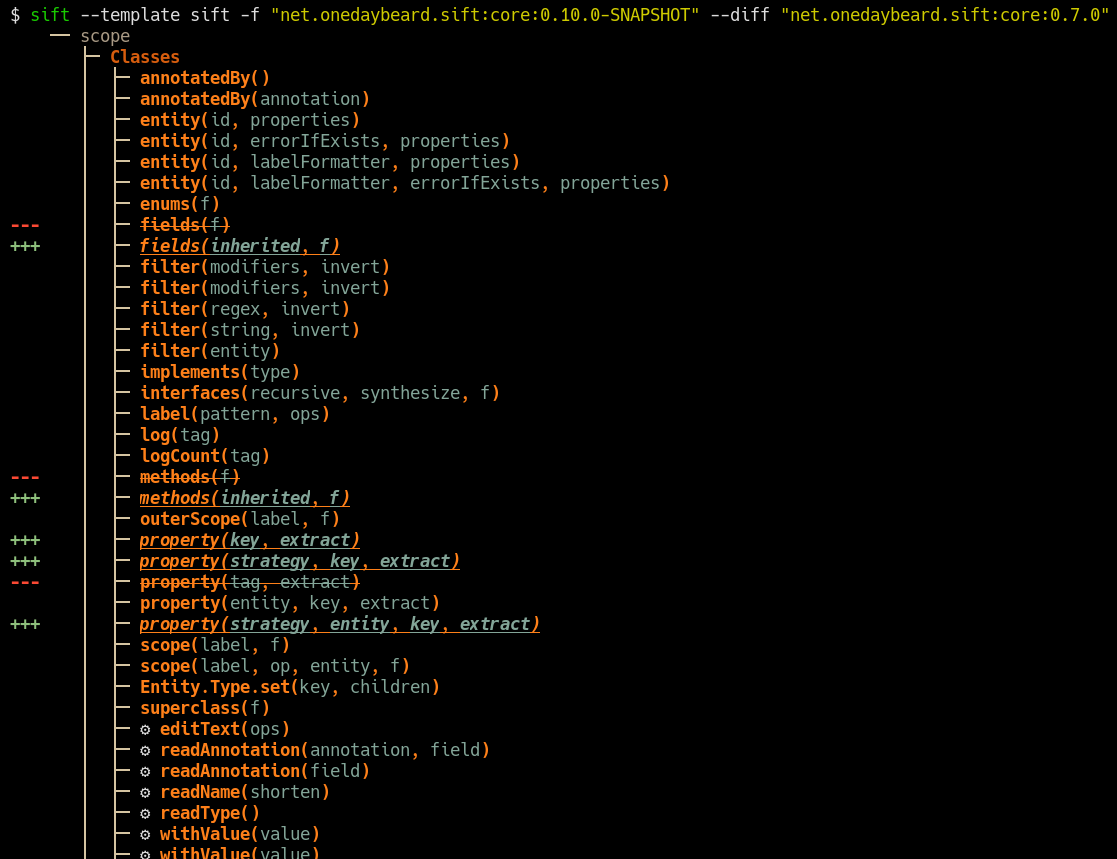
The sift template now enables direct comparison between releases without any
local prerequisites. Previously, one needed to have the older .jar locally available and execute a --save on
the older version before running --diff <OLD_VERSION.JSON>. The new release simplifies the process. Now,
the --diff command can be applied directly to Maven coordinates, eliminating the previous steps. For example:
sift --template sift -f "net.onedaybeard.sift:core:0.10.0" --diff "net.onedaybeard.sift:core:0.9.0" to
identify changes to the API in the latest release.
- Introduced
RegexTypefor flexible type matching using regular expressions. Use the.regexTypeextension function on a string, or.typeon a Regex, to create a RegexType. For example,Regex("java.util.*").typematches all types in the java.util package. DSL methodsimplements(),filterType()andannotatedBy()have been updated accordingly. -foption has been updated to also support URI paths and maven coordinates, for example:sift -f https:///path/to/classes.jar ...andsift -f net.onedaybead.sift:core:0.9.0 ....--diffnow also works against class directories, jars, URI:s and maven coordinates. This means that it is no longer necessary to--savethe system model before running--diff, e.g.:sift --template sift -f net.onedaybead.sift:core:0.9.0 --diff net.onedaybead.sift:core:0.7.0--maven-repositoryoption has been added to specify additional Maven repositories for downloading artifacts. By default, Maven Central and local user repositories are always included.- Remaining usages of
org.objectweb.asm.Typereplaced withsift.core.dsl.Type. sifttemplate: DSL methods for dealing with entity properties are now prefixed with a ⚙️ icon.- DSL: The
forkactions displayed when using the--profileflag now incorporate the labels from thescope()functions.
siftrc.shandsiftrc.zshreplaced bysift.config. Update custom configurations to this new file.
Entities can now be registered against generic type signatures, such as Repository<User>. This first iteration
does not cover all use-cases, specifically type arguments inferred from context are currently not resolved,
leading to sift ignoring the generic signatures of method invocations.
The sift.core.dsl.Type class supersedes org.objectweb.asm.Type usage in the DSL. The new type
class supports incorporating generic type information and is generally easier to work with. Instances
of the new Type class are created with the type() function or the String.type extension property,
for example: type("java.lang.String") and "java.lang.String".type.
Entity properties now overwrite existing properties by default, instead of appending to them . You can
can modify this behavior by specifying the strategy parameter in the property() function. For example:
property(PropertyStrategy.unique, foo, "labels", withValue("hello"))Property strategies are one of: replace, append, prepend, immutable and unique.
- DSL/Class: added
inheritedparameter tomethods()andfields()to include inherited methods and fields. - Enhanced performance primarily focused on element trace optimizations - the process of interrelating elements as they are navigated by the DSL. This enhancement reduces the total execution time by up to 40% for complex templates.
- DSL/Method:
filterName()added string overload forname. - DSL/Method:
fieldAccess {}to iterate accessed fields. - Entity elements of
Entity.Type.fieldAccesscan now be either fields or classes. If the latter, then the type of the field is used. - siftrc.zsh|sh is now created under
~/.local/share/sift/. It currently holdsSIFT_ARGS, CLI options always appended. --stastisticsprints statistics about the state from the execution of the system model template.
- TODO: methods affected by
Typechange
- sift template:
objectActions were not associated with their DSL methods.
A short template for the Game Rental demo application. It demonstrates
how to work with JPA entities, and wires axon entities against @MessageMapping endpoints.
--tree-rootoption is now repeatable, allowing you to specify multiple roots. For example:sift -t spring-axon -r command -r query ...--list-templatesoption now displays a brief description for each template.--dump-system-modeloption now converts entity UUIDs to integers, making the output more readable.
DSL.property(): would sometimes fail to update entity properties.sifttemplate: fix DSL registration.- IllegalArgumentException for methods declaring thrown exceptions as generic types, e.g.:
public static <X extends Throwable> void propagate(Throwable t) throws Xspring-axon: no longer fails if a@Controllerdoesn't register any REST endpoints.
DSL documentation published to https://junkdog.github.io/sift/
This is a short, custom template for the Spring Boot Pet Clinic demo application. It demonstrates how to combine existing templates with custom templates, describes relationships between entities, and configures properties for Graphviz visualization.

--profilenow includesety#column, tracking entity registrations.--stacktraceto print stacktrace on errors.- DSL/Core:
editText(TextTransformer...)forproperty(), currently used bygraphviz(). - DSL/Elements: inherits from
Core, making it a bit more useful.
- DSL: changed package to
sift.core.dslfromsift.core.api. - DSL/Template:
graphviz(label=List<TextTransformer>)replacesremoveSuffixargument. - All scopes (Template, Classes, Methods...) are now top-level classes.
- DSL/Core: restricted value of
withValue(value)to String, Number, Boolean, Enum. This solves a lot of issues with serialization.
- DSL/property: Improved the
property()method to resolve relationships via direct association first. If direct association fails for all entities, it falls back on identifying relationships through shared common associations. The old behavior was to rely solely on shared common associations, but this could produce false positives. - Fix NPE when
--list-entity-typesis used with no path argument. --list-entity-typesnow resolves entity counts when system model is deserialized with--load.
- DSL.Template:
classesOf()/methodsOf()/fieldsOf()now passes along the Entity.Type as a lambda parameter. - DSL.Template:
entity[key] = foo.(instantations|invocation|fieldAccess), replacingregisterInvocationsOfandregisterInstantiationsOf. - DSL.Class:
interfaces(recurisve, synthesize)iterates interfaces of inspected class nodes. - DSL.Class:
filter(Modifiers..., invert)iterates classes with matching modifiers. - DSL.Class:
enums {}opens a field scope iterating all enum values (as static final fields). - DSL.Field:
filterType()of fields. - DSL.Field:
filter(Modifiers..., invert)iterates fields with matching modifiers. - DSL.Method:
filter(Modifiers..., invert)iterates methods with matching modifiers. - DSL.Parameter:
filterType()of parameters. - dot: Remove need for specifying
"dot-ignore"property. - DSL: re-registering the same entity using
entity(entitty, label...)will now update the entity label. - CLI:
--edge-layout=spline|polyline|ortho, used together with-R/--render. spring-axon: member aggregate label changed to$aggregate[$member].spring-boot: base template, extended byspring-axon.
- Instrumenter Service renamed to System Model Template:
- pipeline() is now template()
instrumenter {}is nowtemplate {}
DSL.Instrumenter.graphviz(): parameterstripLabelSuffixrenamed toremoveSuffix.- Entity Types can can only be associated with a single element type (class, method, etc).
- Internal visibility on many classes previously marked as public.
spring-axon: fix member aggregate identification when field type is a Map.spring-axon: improved identification of projections.- Inadvertent exclusion of entities from the tree if the added entity also occurred as a parent.
- graphviz: childless entities could throw a NoSuchElementException.
"Reverse registration" of invocations and instantiations of entities is now possible. This means that,
in addition to foo["a"] = bar.instantations and foo["b"] = bar.invocations, we can now also register
instances of foo that are invoked or instantiated by bar:
methods {
    // note that `bar` represents the contextual method elements in the current scope
    foo.invocations["invoked-by"] = bar
    payload.instantations["created-by"] = bar
}The TextTransformer interface provides static functions for updating entity labels:
dedupe: removes duplicate instances of a specified character.replace: replaces all occurrences of a specified string or regular expression with a given replacement string.idSequence: replaces matches of a given regular expression with sequentially assigned values, starting at 1.uuidSequence: replaces UUID:s with sequentially assigned values, starting at 1.
The label function has been updated to take TextTransformers as a vararg parameter, and applies them in order:
entity(E.endpoint,
    label("$method /\${base-path:}\${path:}",
        dedupe('/'),                 // drop repeating '/'
        replace(COMMON_PREFIX, "")), // shorten URL
    property("path", readAnnotation(httpMethod, "value"))
)The Elements context is a type-erased scope that only provides methods defined by the Core scope class.
This new scope adds a layer of abstraction to the DSL, making it easier to reuse code and update properties
in a more flexible way.
- DSL.Parameter: generic
signature {}scope. - DSL.Method: Reverse association with
foo.instantiations["created-by] = barandfoo.invocations["called-by] = bar - DSL.Signature:
explodeTypeT(signature) {}extracts typeTfrom signature pattern, e.g.Map<String, List<T>>._matches any type. - DSL.Instrumenter:
elementsOf(e) {}iterate over all entities without element-specific methods. Useful for property tagging. - DSL.Instrumenter:
graphviz(e, ...)which allows setting graphviz properties such as identifier, rank, type, shape, style, etc. - DSL:
filter(string)is a short-hand forfilter(Regex.fromLiteral(string)) spring-crudinstrumenter - very similar tojpa.
- Multiple classes changed packages and visibility; ongoing.
GruxboxandStylemoved tosift.core.terminalfromsift.instrumenter.- SPI:
InstrumenterServiceProvideris now optional when implementingInstrumenterServicesince json serialization is typically more convenient. - Due to some internal renaming, any custom pipelines need to be recompiled/resaved to work with the new version.
Style.plain()no longer accepts optionaldedupeargument as that functionality is now taken care of by TextTransformers.
- Entities were sometimes not relatable when calling
property()from a scope not directly related to the scope which registered the entity.
Signature Scope: Limited DSL support for exploring generics/type signatures, e.g. Foo inside List<Foo>.
Note that entities cannot be registered inside the signature scope. The type argument has to be registered by
its raw class, using explodeType() {}.
Support for method parameter signatures is currently lacking from the DSL.
sift Self Instrumenter: A new instrumenter has been added that extracts the system model centered around
the DSL. This instrumenter allows you to compare the changes to the DSL between releases using the --diff option.
Currently, Sift does not have support for resolving Kotlin constructs, so some of the DSL method names may
be mangled.

- DSL.Class:
outerScope {}inner classes iterate over their outer classes. - DSL.Class:
superclassSignature(synthesize=false) {}- parent class signatureFoo<Bar>; skips non-generic parents (WIP). - DSL.Field:
explodeType(synthesize=false) {}iterates class elements of fields. - DSL.Field:
signature(synthesize=false) {}- generic field signature; skips non-generic fields. - DSL.Method:
filterName()only inspects the method name;filter()also checks the class name. - DSL.Method, DSL.Field, DSL.Parameter: entity property method
readName(). - DSL.Method:
returns(synthesize=false) {}signature scope for method return - DSL.Signature:
explodeType(synthesize=false) {}- class scope of current type arguments. - DSL.Signature:
filter(Regex)- filters concrete type argument by class name. - DSL.Signature:
scope {}- local scope, as found elsewhere. - DSL.Signature:
typeArgument(index) {}- filters nested type argument by position. - DSL.Signature:
typeArguments {}- iterate nested type arguments. - DSL:
readName(shorten=true)shortens names of inner classes. - Dot entity property
dot-shapeaccepts valid graphviz shapes - Entity labels: extract all
- property values by prefixing the property name with
+. E.g.${+property}.
- DOT: illegal node ids containing
.and$.
- graphviz property
dot-idrenamed todot-id-as. - updated spring-axon grahpviz to use
dot-shape.
- DSL:
updateused for updating properties on existing entities is renamed toproperty. - DSL:
parentScoperenamed toouterScopein the name of clarity.
- introspection of kotlin's noinline lambdas
- CLI:
--render/-Rprints entities in graphviz's DOT language.sift.zshandsift.shautomatically pipe to graphviz and displays the diagram inline. Note that-Rwill print the DOT script to stdout.
- CLI:
--dump-system-modelprints all entities and their properties. Primarily useful for debugging. sift.sh, QoL script similar tosift.zsh

mvn installinstalls the executable into~/.local/share/sift/bin. If compiling with-P native-image, the native sift executable is also copied.- "backtrack" references are now added to all child entities.
- CLI:
-freplaces PATHS argument; filter changed to-F
- CLI:
--versionoption - CLI:
--save/-ssave the resulting system model as json - CLI:
--diffcompares a previous model with the current state - CLI:
--loadrestores a previously saved model instead of instrumenting classes
- initial release