Python Trending Weekly #111: Django Celebrates 20th Anniversary, Former OpenAI Employee Shares Work Experience
Welcome to Python Trending Weekly - your gateway to cutting-edge Python intelligence! Curated by Python Cat from 400+ premium sources worldwide, we deliver the most valuable articles, tutorials, open-source projects, tools, podcasts, videos, and trending discussions directly to your inbox. Our mission: Accelerate your Python mastery and unlock new career opportunities in the ever-evolving tech landscape.
Stay ahead of the curve: Subscribe now for weekly insights that keep you at the forefront of Python innovation!
1、Happy 20th birthday Django! Here's my talk on Django Origins from Django's 10th
Django's origins trace back to a small newspaper in Lawrence, Kansas in 2003, where two developers, frustrated with PHP's limitations, decided to build a new web framework using Python. The father of Django recalls the creation process from scratch, revealing the thinking behind technical choices—an inspiring look at how open source projects evolve.
2、Exploring Llama Stack with Python: Tool calling and agents
A comprehensive guide on using Python with Llama Stack for tool calling and agent development. Starting from environment setup, it demonstrates the complete workflow of tool definition, function implementation, and API calls, with special emphasis on API exploration techniques using documentation endpoints—a practical LLM development guide.
3、From SQL To SQLModel: A Cleaner Way To Work With Databases In Python
SQLModel, open-sourced by the creator of FastAPI, replaces SQL queries with Python objects and type annotations for database operations. Built on Pydantic and SQLAlchemy, it provides data validation, IDE support, and better testability, significantly improving code cleanliness and maintainability.
4、Inheritance over composition, sometimes
The author provides an in-depth comparison of three approaches to implementing hybrid concurrent executors: inheritance offers the cleanest code with best forward compatibility, composition requires extensive boilerplate code, and pure functions are simple but suffer from global state issues—challenging the traditional "composition over inheritance" wisdom.
Shares a modern workflow for managing Python projects using GNU Make. By simplifying Makefiles and combining with the uv tool, it achieves cross-platform automated project management, including virtual environment creation, dependency installation, and complex build processes.
6、Making a Simple HTTP Server with Asyncio Protocols
This article explains how to build HTTP servers using Asyncio Protocols, a low-level callback mechanism. Compared to high-level Streams abstractions, Protocols avoid coroutine overhead and respond faster to network events, with performance tests showing roughly 8x faster speeds than FastAPI.
7、A Deep Dive into DuckDB for Data Scientists
This article introduces the core features of DuckDB, an embedded SQL database, showcasing its advantages in memory efficiency and performance compared to pandas. It demonstrates zero-configuration DuckDB usage, seamless integration with pandas/Polars, and automatic parsing capabilities for various file formats.
8、I'm Switching to Python and Actually Liking It
The author switched to Python due to AI development needs and shares a complete toolchain from scripting tools to production-grade applications. Using tools like uv, ruff, and FastAPI to build a monorepo architecture, combined with Docker and GitHub Actions for automated deployment, showcasing the maturity and development efficiency of the Python ecosystem.
9、2048: iterators and iterables
The author encountered iterator pitfalls while developing a 2048 game, explaining the difference between range() returning reusable iterables and reversed() returning one-time iterators. Using itertools.product() cleverly solves iterator reuse issues in nested loops, sharing core concepts of Python's iteration mechanism in an accessible way.
10、How to Get Foreign Keys Horribly Wrong
This article dissects common Django foreign key pitfalls and optimization techniques, from replacing unique_together to identifying duplicate indexes, and safely migrating foreign key constraints. It provides detailed explanations on avoiding blocking migrations and implementing concurrent index operations—critical issues in production environments.
11、Application Logging in Python: Recipes for Observability
This tutorial covers everything from the four core components of the logging module to JSON format output, YAML configuration, and asynchronous processing. It comprehensively covers logging system development practices—a practical guide for production environment logging system development.
A former OpenAI employee shares authentic work experiences. From bottom-up research culture to all-Slack communication, from the crazy 7-week Codex development pace to Python monolithic repository architecture, revealing the internal operations and engineering practices of this AI giant.
13、How to Think About LLMs for OSS Development
Based on 25 years of open source development experience, the author proposes a rational thinking framework for applying LLMs in open source software. Emphasizing that open source collaboration is essentially a complex social dynamic system, they recommend cautious LLM use only in learning and creation, while maintaining human leadership in open source collaboration.
1、Kimi-K2: Open Agentic Intelligence
An open-source model from Moonshot AI with 32B active parameters and 1T total parameters, supporting 128K context length. Trained using the Muon optimizer, it excels in cutting-edge knowledge, reasoning, and programming tasks. (5.4K stars)
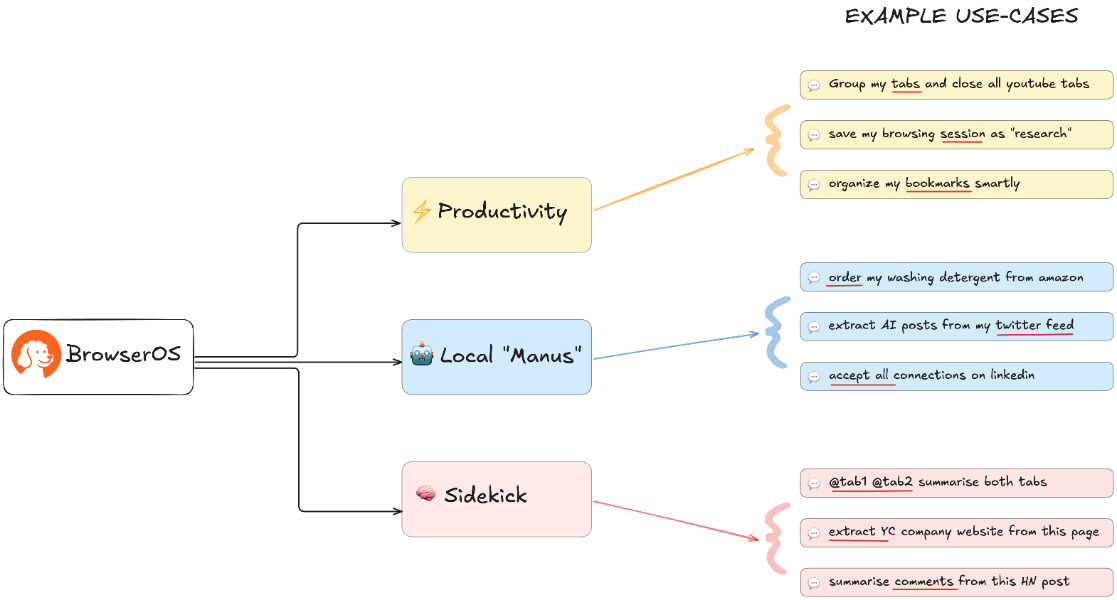
2、BrowserOS: BrowserOS is an open-source agentic web browser
An open-source agentic browser based on Chromium, focused on privacy protection and local AI processing. It supports using your own API keys locally or running local models through Ollama, capable of performing repetitive tasks like web form filling and data extraction. Future plans include MCP store support and built-in AI ad blockers. (2.5K stars)
3、macOS-use: Make Mac apps accessible for AI agents
A tool that enables AI agents to interact with MacBooks, capable of performing tasks from simple calculator operations to complex web logins. The project's vision is to let AI agents perform any operation on any Apple device, with future plans to support local inference and iPhone/iPad devices. (1.5K stars)
4、SuperClaude: A configuration framework that enhances Claude Code
A configuration framework that enhances Claude Code, providing 16 specialized commands, intelligent role systems, and MCP server integration. It supports various programming tasks including development, analysis, and quality control, using intelligent routing to select appropriate tools and experts for smoother development workflows. (8.5K stars)
5、pymanager: The Python Install Manager (for Windows)
Python's official Windows platform Python installation manager, based on PEP 773 proposal. It supports multi-version Python management and automated installation configuration, providing both MSIX and MSI package formats to simplify the Windows environment management experience.
6、mcp-for-beginners: Model Context Protocol (MCP) Curriculum for Beginners
An open-source tutorial from Microsoft, containing examples in .NET, Java, TypeScript, JS, and Python. From basic concepts to advanced topics, it includes a complete learning path covering server construction, client development, security practices, and multimodal integration. (5.2K stars)
7、acp: Open protocol for communication between AI agents, applications, and humans
An open protocol for AI agent communication, supporting multimodal messaging including text, code, files, and media content, with real-time, background, and streaming responses. Features agent discovery, long-term task collaboration, and state sharing capabilities, complete with Python and TypeScript SDKs.
8、RapidOCR: Awesome OCR multiple programing languages toolkits
A multi-platform, multi-language OCR toolkit based on ONNXRuntime, OpenVINO, PaddlePaddle, and PyTorch. Supports Chinese and English recognition with fast offline deployment, providing interfaces for Python, C++, Java, C#, and other languages. (4.6K stars)
9、Voxtral: State-of-the-art speech understanding models
Open-source speech understanding models released by Mistral AI, available in 24B and 3B versions. Supports up to 30-minute speech transcription, built-in Q&A and summarization, multilingual support, and direct function calling from speech, surpassing existing models like Whisper in transcription accuracy and semantic understanding.
10、html-to-markdown: HTML to markdown converter
A Python library rewritten based on markdownify, supporting complete HTML5 element conversion. Features strict type safety, metadata extraction, streaming processing, highlighted text support, task list conversion, and more, with 100% code coverage.
11、aiosqlitepool: A resilient, high-performance asynchronous connection pool layer for SQLite
A high-performance connection pool designed for asynchronous SQLite applications, eliminating connection overhead through long connection reuse and maintaining SQLite memory page cache warmth to significantly improve concurrent query performance. Supports connection health checks, automatic transaction rollback, and idle connection replacement, achieving up to 72% query throughput improvement under high load.
12、epub-translator: Use LLM to losslessly translate EPUB e-books
Uses large language models to translate EPUB e-books while preserving original formatting, illustrations, table of contents, and layout, generating bilingual parallel versions. Supports multilingual translation, custom prompts, multiple AI model choices, and high-performance parallel processing.
13、ai-engineering-hub: In-depth tutorials on LLMs, RAGs and real-world AI agent applications
Tutorial resources on LLMs, RAG, and AI agents, containing a complete learning path from basic concepts to practical applications. Covers cutting-edge technologies including multi-agent systems, speech processing, document analysis, and knowledge distillation, with rich practical cases and code examples. (14.3K stars)