| timezone | UTC+8 |
|---|
GitHub ID: SunWeb3Sec
Telegram: @huangSun
最近都在研究AI Payment and AI Security, 藉由此活動希望認識更多志同道合的朋友:D
ERC-8004 Overview & Trust Layer Primer
Objective (today)
- Understand what ERC-8004 is solving, its three registries (Identity / Reputation / Validation), and the “events-first” design.
---
Why ERC-8004 (problem framing)
Modern agents need to discover each other, establish minimal trust, and settle outcomes across org or platform boundaries. ERC-8004 proposes a credibly neutral trust layer on Ethereum so agents can be discovered, chosen, verified, and audited without pre-existing trust. It does this by standardizing on-chain registries while pushing complex scoring and analytics off-chain for flexibility.
ERC-8004 — Three Registries (Implementation-Oriented Explainer)
- Identity Registry
What (Purpose)
Provide each agent with a portable, censorship-resistant on-chain identifier. Keep the on-chain footprint minimal (a pointer), and store rich metadata off-chain (Agent Card/descriptor, DID doc, JSON).
How (Data model)
-
ERC-721 + URIStorage: each tokenId = one agent identity
-
tokenURI(tokenId) points to a registration file describing capabilities, endpoints, public keys, payment options, etc.
-
Off-chain file may include mappings across identifiers (ENS/DID/URL/Domain). On-chain keeps only the primary URI.
Minimal Interface (example)
interface IIdentityRegistry {
event AgentRegistered(address agent, uint256 tokenId, string uri);
event AgentURIUpdated(uint256 tokenId, string oldUri, string newUri);
function registerAgent(address agent, string calldata uri)
    external returns (uint256 tokenId);

function tokenURI(uint256 tokenId) external view returns (string memory);
function ownerOf(uint256 tokenId) external view returns (address);
}
Typical Flow
-
Caller invokes registerAgent(agent, uri) → mints an ERC-721 as the identity anchor
-
Anyone calls tokenURI(id) → fetches the off-chain Agent Card (descriptor/public keys/services)
-
To update metadata, emit AgentURIUpdated so indexers can track versions
Design Notes
-
Primary ID + mapping table: choose ENS or DID as the primary; publish mappings to avoid lock-in
-
Versioning: append commit/version hints to the URI (e.g., …/card.json#v=2025-10-13) for auditability
-
Key rotation: keep rotation data/signatures in the off-chain file; restrict updates via ownerOf(tokenId)
- Reputation Registry
What (Purpose)
Record interaction outcomes and quality signals as events (success/failure, latency percentiles, refund/dispute flags, settlement references). Avoid a single global score; enable a signal marketplace where third parties aggregate or weight differently.
How (Data model)
-
Prefer events as the canonical record of facts
-
Optionally expose a tiny set of view helpers (e.g., recent N entries) for convenience
-
Standardize event fields to make third-party indexing easy
-
Authorization flow: when the Server Agent accepts a task, it pre-authorizes the Client Agent to submit feedback after completion
Events & Interface (example)
interface IReputationRegistry {
event ReputationEvent(
bytes32 traceId,
address actor,
address counterparty,
string capability,
bool success,
uint64 latencyMsP95,
bytes32 paymentRef,
bytes32 integrityHash,
string evidenceURI
);
function emitReputation(
    bytes32 traceId,
    address actor,
    address counterparty,
    string calldata capability,
    bool success,
    uint64 latencyMsP95,
    bytes32 paymentRef,
    bytes32 integrityHash,
    string calldata evidenceURI
) external;

function getRecent(address agent, uint256 limit)
    external view returns (/* compact array type */);
}
Typical Flow
-
After a call completes, your business/agent contract emits ReputationEvent
-
Indexers pull events → warehouse (e.g., BigQuery/ClickHouse) → dashboards & KPIs
-
External raters/auditors/insurers build scene-specific scores by weighting signals differently
Anti-abuse Tips
-
Sybil/self-dealing: perform graph analysis on counterparty; require validation evidence on a sample
-
Replay: enforce unique traceId/paymentRef; include nonce + deadline where applicable
-
Auditability: align integrityHash with (masked) input/output; host immutable evidenceURI (IPFS or versioned storage)
- Validation Registry
What (Purpose)
Standardize independent verification: request checks by third parties (re-execution, ZK, TEE, human judges) and record results on-chain. Produce an auditable chain of evidence tied to a reputation record.
How (Data model)
-
Two-phase events: Request → Recorded Result
-
Identify method as an enum or string: "sampling" | "zk" | "tee" | "judge"
Interface (example)
interface IValidationRegistry {
enum Method { Sampling, ZK, TEE, Judge }
event ValidationRequested(
    bytes32 jobRef,
    address requestor,
    Method  method,
    string  evidenceURI
);

event ValidationRecorded(
    bytes32 jobRef,
    Method  method,
    bool    verdict,
    string  proofRef,
    bytes32 relatedHash
);

function requestValidation(
    bytes32 jobRef,
    Method method,
    string calldata evidenceURI
) external;

function recordValidation(
    bytes32 jobRef,
    Method method,
    bool verdict,
    string calldata proofRef,
    bytes32 relatedHash
) external;
}
Typical Flow
-
Someone calls requestValidation(jobRef, method, evidenceURI) (buyer/auditor/policy bot)
-
Validator runs off-chain (re-executes, builds ZK proof, produces TEE attestation, or renders judgment)
-
Validator (or an authorized recorder) calls recordValidation → on-chain verdict/proofRef cross-linked via relatedHash
Security/Governance
-
Who can record? Whitelisted validators or staked sets subject to slashing
-
Evidence availability: proofRef must resolve (ZK proof, TEE quote/attestation, logs + hashes)
-
Sampling policy: e.g., 1/N random checks or mandatory for high-value/high-risk requests
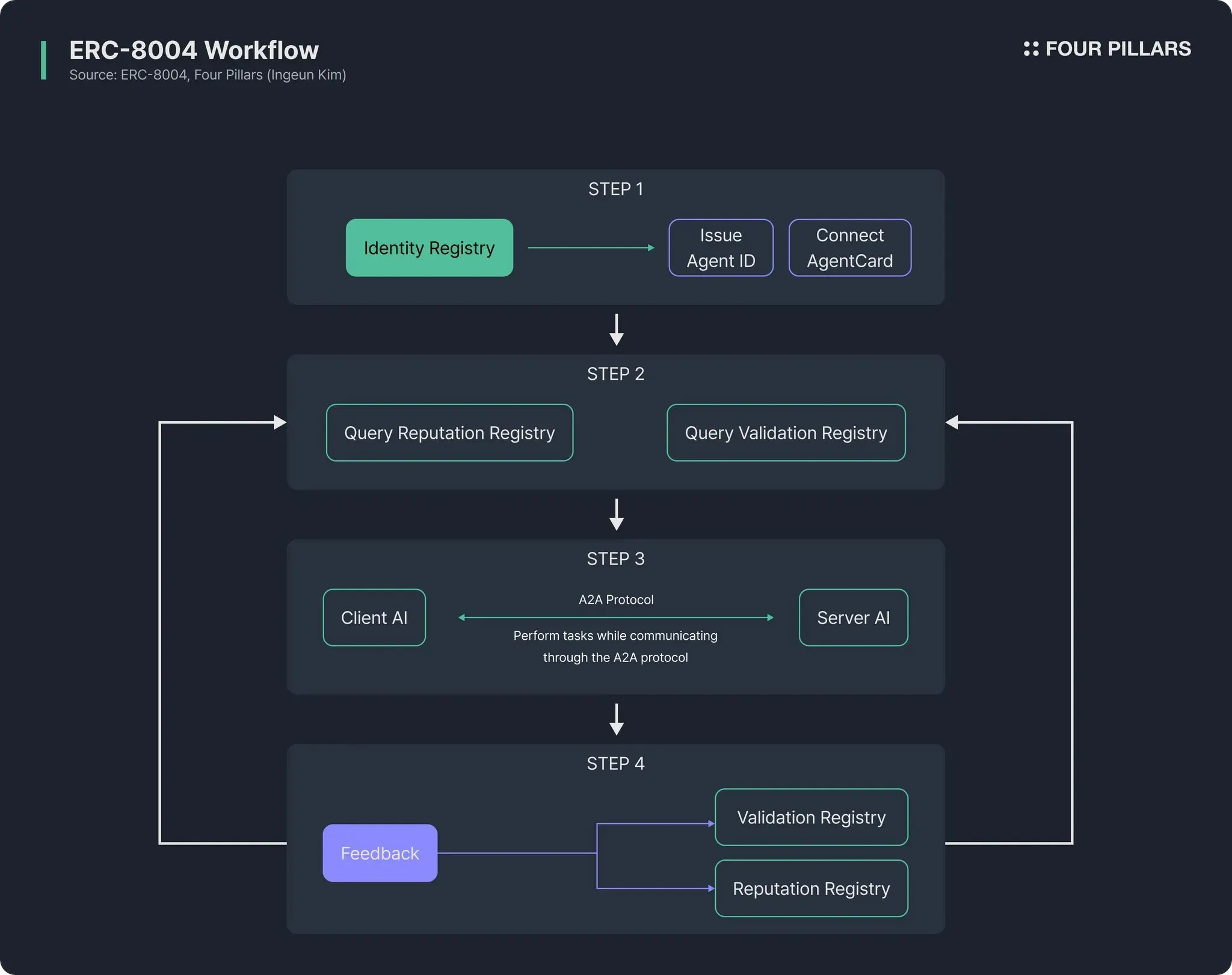
How the Three Registries Work Together (End-to-End)
-
Identity: agent registers → tokenURI → descriptor.json
-
Interaction & Settlement: call service / pay (x402 / EIP-3009 etc.)
-
Reputation: emit event with outcome, latency, paymentRef, integrityHash
-
Validation (optional/sampled): request a check for jobRef/traceId → record verdict/proofRef
-
Index & Aggregate: third parties combine Reputation + Validation to produce auditable scores and risk signals