 SSCHA
SSCHA

Replies: 1 comment 1 reply

-
|
Hi Ren, Reguarding the other questions:
The 3 indicates the number of irreducible q points by symmetry (i.e. the number of dynamical matrix files produced by quantum espresso). PbTe in the cubic Fm-3m structure has 48 symmetry operations, and the 8 q points of the 2x2x2 supercell reduce, once symmetries are applied, to 3 points. So, the quantum espresso dynamical matrices are 3 independent (loaded from the files).
This is a unit conversion. I understand that it not so clear, however, the FORTRAN subroutines of the SSCHA code works in Hartree atomic units, while the rest of the code uses in Rydberg atomic units (this is a consequence of merging a part of an old FORTRAN implementation of SSCHA with some subroutines from quantum espresso and CellConstructor). The file d3_realspace_sym.npy is expressed in Hartree units and needs to be converted in Rydberg before further processing (1 Ha = 2 Ry).
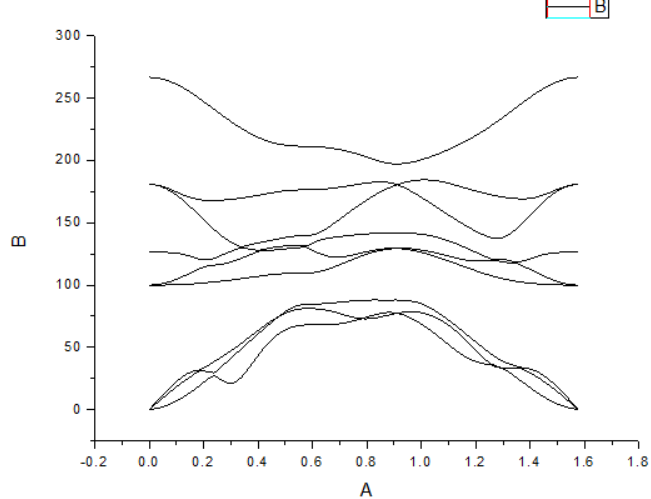
You tried to use espresso q2r.x and matdyn.x to plot the phonon dispersion from the NbTe2.Hessian.dyn file and you get a meaningless spectrum, correct? Bests, |
Beta Was this translation helpful? Give feedback.

-
|
Dear Lorenzo, |
Beta Was this translation helpful? Give feedback.


Uh oh!
There was an error while loading. Please reload this page.
-
Dear developers,
Thanks for your effort for developing and releasing this program. Recently, I have analyzed the anharmonic effect in 2D materials monolayer NbTe2. Things are going well. After calculating 1400 structures, the convergence is successful!However, there are some problems in imposing the acoustic sum rule (ASR). Error displays Segmentation fault. After checking, the possible reason is that the array is out of bounds. Have you ever had a problem like this?The supercell is 4x4x1. What can I do about that?
Then I try to use the NbTe2.Hessian.dyn (I know the frequency coming from the SSCHA free energy Hessian is not a true physical quantity) instead of the harmonic matrix in calculation of phonon spectrum by QE. For the reason, in the tutorial, it writes "The matrices PbTe.Hessian.dyn#q are a generalization of the standard harmonic dynamical matrices that include quantum and thermal effects on a static level." The static level cann't be improved by convenient QE calculation in q2r.x and matdyn.x. I guess? So it's wrong? The spectrum is meaningless.
By the way, in the PbTe spectral functions tutorial, in the part for applying ASR, dyn = CC.Phonons.Phonons("PbTe.SSCHA.dyn",3) seems that 3 should be 8. And I don't get the reason *2.0 in the " d3 = np.load("d3_realspace_sym.npy")*2.0". It will be greatly appreciated if you could spare time to answer my questions.
Regards,
Ren
Beta Was this translation helpful? Give feedback.
All reactions